
Contact US

What Is E-E-A-T and Why It Matters More in the Age of AI Search
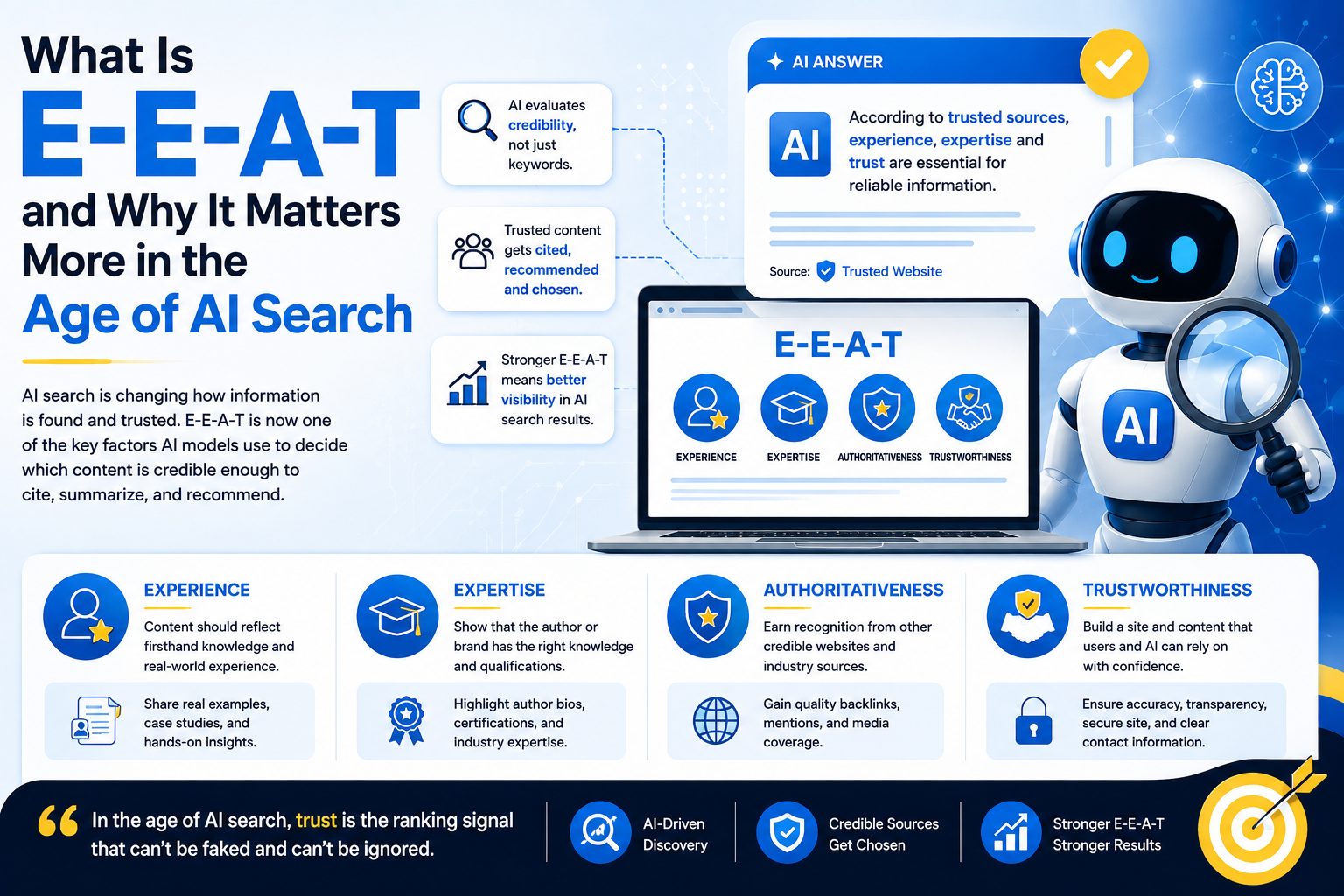
Google introduced E-E-A-T years ago as a way to judge content quality, and most SEO teams treated it as a ranking checklist. That thinking has to change. E-E-A-T in AI search is no longer a background signal buried in a search quality guideline. It is now one of the main filters AI models use to decide whose content gets cited, summarized, and recommended to a buyer.
When ChatGPT, Gemini, Claude or Perplexity answer a question, they are not just retrieving a page and ranking it. They are deciding which source sounds credible enough to speak for. That decision leans heavily on experience, expertise, authoritativeness, and trust, the four pillars behind the acronym.
What does E-E-A-T stand for in SEO?
E-E-A-T stands for experience, expertise, authoritativeness, and trustworthiness, the four signals search engines and AI models use to judge content quality.
How does E-E-A-T affect the way AI tools like ChatGPT rank content?
AI models rely on E-E-A-T signals to determine which sources are credible enough to cite, often more heavily than traditional keyword relevance alone.
What E-E-A-T Actually Stands For
The acronym breaks down into four distinct signals:
- Experience — the content reflects firsthand knowledge rather than a rehashed summary of other articles
- Expertise — the person or brand behind the content has real qualifications in the subject
- Authoritativeness — other credible sources point to the brand as a reference point
- Trustworthiness — the site is accurate, transparent, and safe to rely on, from contact information down to data security practices
None of these are new concepts. What has changed is how directly AI systems weigh them when choosing what to surface. A page can rank fine on a traditional search engine while still getting passed over entirely when a model decides which source to quote in a generated answer.
Why E-E-A-T Matters for AI Search
Traditional search lets a page rank reasonably well on keyword relevance alone. AI search does not work that way. Understanding the differences between AI SEO and traditional SEO is becoming increasingly important as search behavior changes. A model generating a single answer has to pick one voice to trust, and it leans on the same signals a human editor would: does this source know what it’s talking about, and has anyone else vouched for it.
This is why brands with thin, generic content are increasingly invisible in AI-generated answers even when their traditional SEO metrics look fine. AI models are cross-referencing entities across the web, not just parsing a single page in isolation. A company with strong case studies, named experts, and consistent information across its site and third-party listings gives a model far more to work with than a page full of vague claims. These signals are also an important part of AI SEO services designed to help search and AI platforms better understand a business and its expertise.
For B2B and industrial brands specifically, this shift raises the stakes. Buyers researching a supplier or technology partner are asking AI tools who to trust before they ever visit a website. Weak E-E-A-T signals mean a real, capable business can get skipped in favor of a competitor whose content simply gives the model more to verify.
How to Improve E-E-A-T for AI Search
Strengthening E-E-A-T comes down to five concrete actions:
- Name the people behind the content — a blog post written by a named subject matter expert with a real bio carries more weight than anonymous copy, both to a human reader and to a model evaluating expertise
- Back claims with specifics instead of general statements — case studies, project details, and named client outcomes demonstrate experience in a way generic service descriptions cannot
- Keep information consistent everywhere it appears — business name, address, services, and leadership details should match across the website, directories, LinkedIn, and review platforms
- Earn mentions from other credible sources — being referenced on industry publications, partner sites, or client testimonials builds the kind of authority signal a single well-written page cannot generate alone
- Review and refresh older content regularly — a page published years ago with outdated statistics or stale examples signals the opposite of trustworthiness to a model evaluating current accuracy
Inconsistency signals unreliability to both search engines and AI models trying to confirm who a brand is. Set a schedule to update key pages with fresh data, current case studies, and corrected details rather than letting them sit untouched. These credibility signals can also support Answer Engine Optimization (AEO) by making information easier for AI-powered answer engines to understand and surface in relevant responses.
Building Trust That AI Models Can Verify
E-E-A-T used to be a quiet quality signal buried in Google’s guidelines. In the age of AI search, it has become the deciding factor in whether a brand gets cited as a trustworthy source or passed over for a competitor. Strengthening experience, expertise, authoritativeness, and trust is not a one-time project. It requires consistent attribution, specific proof points, and a site that reads as genuinely credible rather than optimized for keywords alone.
We build content and digital presence around these exact signals for our B2B and industrial clients, structuring sites and content so AI models can verify credibility instead of guessing at it. Visit our site to see how our AI Visibility Engine™ approach strengthens E-E-A-T across your entire digital footprint.