
Contact US

How an AI SEO Agency Gets Your Business Found in AI Search

AI Search Visibility in Short
As AI search becomes a critical new channel for brand visibility, more B2B and industrial companies are asking how to earn a place inside AI-generated answers, not just a spot on page one of Google.
This page breaks down what a specialized SEO partner focused on AI visibility actually does, drawing on real client results, from a 47% traffic increase at Global Technology Ventures Inc. to Weldflow Metal Products reaching page one on 34 of its 37 target keywords, so you can see what this work looks like in practice and what to expect from a program built around it.
The main takeaway: AI search isn’t replacing traditional search, it’s replacing your website as the first place buyers engage with your brand. It has created a parallel surface of visibility that determines which businesses get seen and chosen inside AI answers before a user ever clicks. Understanding and optimizing for that surface is the next frontier of B2B visibility.
Buyers no longer start their research with a list of blue links. They open ChatGPT, Perplexity, or Google’s AI Overviews and ask a direct question: “Who are the best industrial coating suppliers near me” or “Which company handles metal fabrication for automotive parts.” The answer that comes back names two or three vendors, sometimes fewer. A business left out of that answer never gets seen by the buyer at all, regardless of how strong its website looks or how long it has been in operation.
As one of our clients, Johnston Industrial Plastics president Michael Runciman, put it after going through this same shift in traditional search, “I now have sales coming in from being found online, and that has never happened before.”
This shift explains why more B2B and industrial companies are rebuilding their search strategy around AI visibility rather than treating it as an afterthought. Traditional SEO still matters, but it was built for a world of ranked lists and blue links. AI search works differently. It synthesizes an answer, cites a handful of sources, and hands the buyer a recommendation before a single click ever happens. Earning a place inside that answer takes a different kind of optimization, one built around how large language models read, weigh, and cite content, backed by our own track record: a 4.9 out of 5 average across 36 independent client reviews.
This page breaks down what that work actually involves, the technical and content frameworks behind it, what our process looks like from the first audit to ongoing monitoring, and what real results have looked like for the businesses we’ve worked with.
Why AI Search Is Changing How B2B Buyers Find Vendors
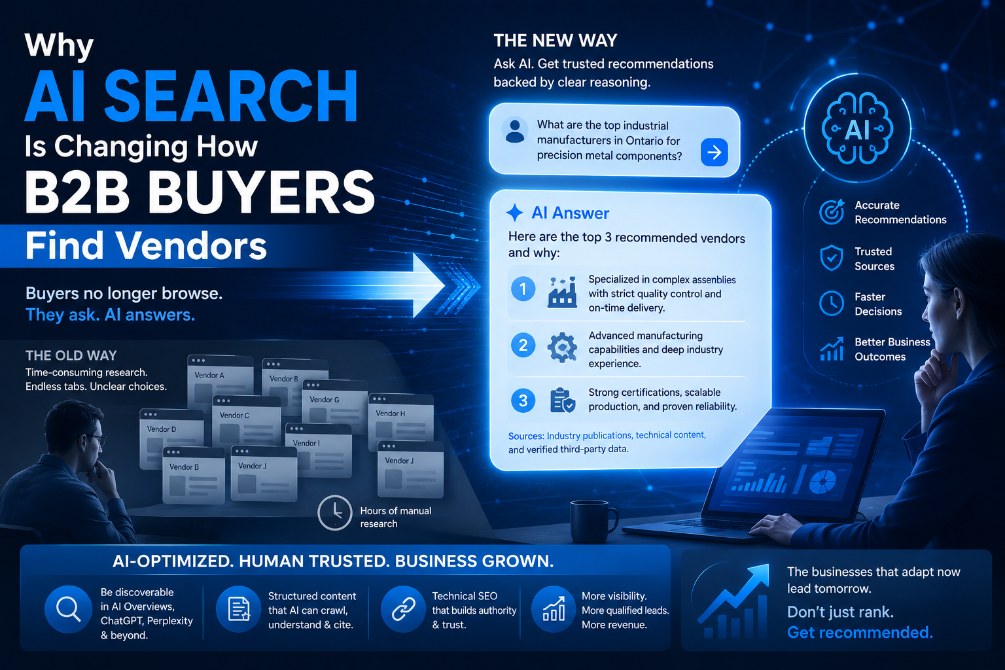
Procurement teams, engineers, and operations managers increasingly treat AI tools as a shortcut past the early research phase. Instead of comparing ten vendor websites side by side, they ask an AI assistant to shortlist the top three and explain the reasoning behind the choice. That assistant pulls its answer from indexed content it treats as authoritative, well-structured, and directly responsive to the question asked.
Two of our clients, Weldflow Metal Products and Canada Metal, both Ontario-based industrial manufacturers, sit squarely inside this shift, since both compete for the same kind of technical, high-value buyers now doing this research through AI tools.
For a manufacturer, distributor, or industrial service provider, this changes the competitive landscape in a specific way. Ranking on page one of Google used to guarantee a shot at the click. Now, a business can rank well in traditional search and still stay invisible in AI Overviews, ChatGPT, or Perplexity when its content isn’t structured for extraction and citation. The two systems reward different signals, and a company optimizing for only one of them is leaving a growing share of the modern search experience uncovered.
Our client SECO USA saw this play out directly, reporting a 35% increase in leads once we realigned its visibility and technical structure.
This is exactly the gap we’re built to close. Our work combines the technical foundation of traditional SEO, crawlability, page speed, and backlink authority, with the newer disciplines of generative engine optimization and answer engine optimization, so your business shows up whether a buyer types a query into Google or asks a question inside a chat window. That combined approach is what we deliver as an AI SEO Agency, and it’s meaningfully different from a standard SEO retainer built around keyword rankings alone.
The scale of the shift is easy to underestimate because it doesn’t show up in a single dramatic metric. It shows up gradually, in fewer direct visits from search, in sales reps hearing “we found you through an AI recommendation” more often, and in competitors suddenly appearing in answers where they never used to. By the time the shift becomes obvious in the numbers, a business has often already lost ground it will need months to rebuild.
Our client Manucan’s experience shows how quickly that ground can be recovered instead: within a year of the website rebuild we led, the company was outranking major platforms like Indeed, LinkedIn, and Monster in its own market, according to CEO Richard C. Fernandes.
What This Kind of Agency Actually Does
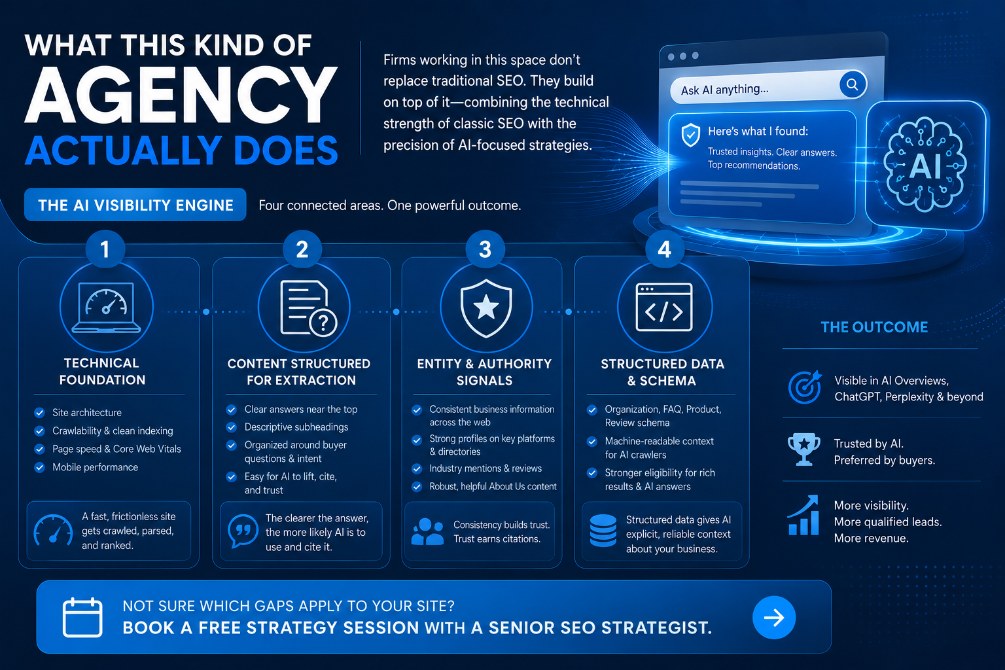
We don’t replace traditional SEO. We build on top of it, structuring our own AI Visibility Engine around four connected areas.
Technical foundation. Site architecture, crawlability, page speed, mobile performance, and clean indexing remain the base layer. AI crawlers and traditional search crawlers both need a site that loads quickly and can be parsed without friction, the same baseline behind our certified Google Partner status.
Content structured for extraction. AI models favor content that answers a specific question clearly, in a format that can be lifted out and cited without ambiguity. This means direct, factual answers placed near the top of a page, descriptive subheadings, and content organized around the exact language buyers use when they type or speak a question.
Our client Identifab saw this play out directly: we moved 17 of its keywords onto page one, five into the first position, largely by tightening how its pages answered specific buyer questions.
Entity and authority signals. Large language models rely heavily on how consistently a business is described across the web: its own site, directories, review platforms, LinkedIn, and industry publications. Mismatched business names, inconsistent service descriptions, or thin “About Us” pages all weaken the entity signal a model uses to decide whether to trust and cite a brand. These credibility signals are closely connected to E-E-A-T in the age of AI search, where demonstrated experience, expertise, authority, and trust can influence whether content is considered a reliable source.
Structured data and schema. Organization schema, FAQ schema, product schema, and review schema give AI crawlers explicit, machine-readable context about who a business is, what it offers, and why it deserves trust. This remains one of the more overlooked levers in AI visibility work, and one of the fastest to implement correctly once a business commits to it.
Our client Terra Greenhouses built this kind of foundation with us over a two-year SEO program before we layered in newer, AI-focused work.
Handled together, these four areas form the backbone of our core AI SEO service line. Handled separately or inconsistently elsewhere, they produce the exact gaps that keep otherwise strong businesses out of AI-generated answers.
The Frameworks Behind AI Search Visibility
A handful of frameworks now sit underneath most AI search strategies. Understanding what each one covers makes it easier to evaluate whether a given approach is complete or missing pieces. These terms often get used loosely, sometimes interchangeably, in marketing materials, which makes it harder for a business owner to tell whether a proposed strategy actually covers the full picture or just repackages traditional SEO under a newer label.
Generative Engine Optimization (GEO)
GEO focuses on how content gets selected, summarized, and cited inside AI-generated answers, whether that’s a ChatGPT response, a Google AI Overview, or a Perplexity result. It prioritizes clarity, factual density, and content structured so a model can lift out a precise answer without misquoting or misrepresenting the source. GEO work often includes rewriting dense technical pages into shorter, more direct passages that still hold the full accuracy of the original content, since a model summarizing a page will favor the version that requires the least interpretation. We track this work as a distinct AI Visibility Results category inside our own portfolio, separate from traditional SEO case studies.
Answer Engine Optimization (AEO)
AEO is closely related but more narrowly focused on question-and-answer formats: FAQ sections, glossary pages, and content built to directly resolve a single query. A well-built AEO page answers the question in the first two or three sentences, then expands with supporting detail for readers who want more context. This format, sometimes called an Extractable Generative Snippet, gives AI models a clean, self-contained answer they can quote with confidence.
E-E-A-T (Experience, Expertise, Authoritativeness, Trustworthiness)
E-E-A-T has been a Google ranking factor for years, but it carries added weight in AI search. Models are trained to favor sources that demonstrate real experience and named expertise rather than generic marketing copy. Author bios, documented case studies, original data, and clear sourcing all strengthen this signal, and their absence is one of the more common reasons a technically sound page still gets passed over. Our client Distinctive Solutions described this kind of expertise directly: “Their managers were extremely knowledgeable, professional, and responsive.”
Entity-Based SEO
Entity-based SEO treats a business, its people, and its services as distinct, well-defined entities that search engines and AI models can map and connect. Consistent naming across platforms, structured business information, and clear relationships between a company and its offerings all feed into this. A business known by three slightly different names across its website, directory listings, and social profiles is much harder for a model to confidently identify and cite.
Our client Canada Metal’s marketing team pointed to the payoff of that consistency after working with us: steady, month-over-month gains in Google keyword ranking and organic traffic.
LLM SEO
LLM SEO is the broader practice of optimizing specifically for how large language models retrieve, interpret, and cite information, including how a model weighs source credibility, recency, and content structure when generating an answer. It sits above the other frameworks as a kind of umbrella discipline, pulling GEO, AEO, E-E-A-T, and entity signals together into one coordinated strategy rather than treating them as separate projects.
Recognition such as our DesignRush Top B2B Digital Marketing Agencies listing reflects the kind of layered credibility this umbrella approach has built for us.
Together, these frameworks explain why AI visibility work looks different from a standard SEO retainer. It isn’t about adding more keywords to a page. It’s about making a business easy for a machine to understand, trust, and quote accurately.
How the Process Works From Start to Finish
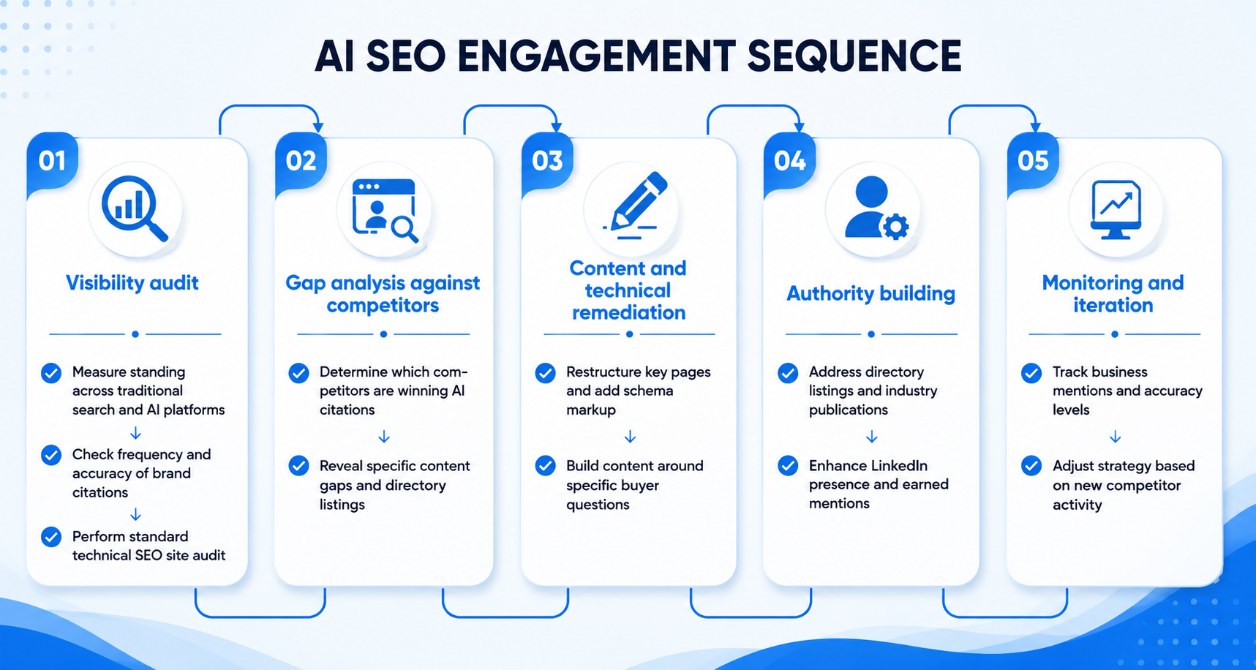
Our engagements follow a similar sequence, though the pace and depth vary based on the size of the business and how competitive its industry is. We walk clients through five stages, each building on the one before it rather than running in isolation.
Visibility audit. We start by measuring where a business currently stands across both traditional search and AI platforms. This includes checking how often, and how accurately, a brand gets mentioned or cited in ChatGPT, Perplexity, and Google AI Overviews, alongside a standard technical SEO audit of the site itself.
Our client Jim Peplinski Leasing, a Canadian vehicle and equipment leasing company, began its program with exactly this kind of audit before any redesign work started.
Gap analysis against competitors. Once the baseline is clear, the next step identifies which competitors are winning AI citations and mentions, and why. This often reveals specific content gaps, such as a competitor’s detailed product spec page outranking a client’s thinner equivalent, or a directory listing that’s simply more complete and current. This is the same analysis we used to help our client OctoChem identify over two dozen search terms it could contest directly against larger, better-known competitors.
Content and technical remediation. This is where most of our work happens: rewriting or restructuring key pages, adding schema markup, fixing entity inconsistencies across platforms, and building new content around the specific questions buyers are asking AI tools. One of our cleaning industry clients saw a 193% improvement in pageviews after this stage of the work.
Authority building. Directory listings, industry publications, LinkedIn presence, and earned mentions all get addressed here, since AI models weigh external validation heavily when deciding what to cite and how confidently to cite it. Our Clutch Top SEO Companies in Canada listing reflects the kind of authority this stage is built to earn.
Monitoring and iteration. AI search behavior shifts quickly. Ongoing monitoring tracks whether a business is being mentioned, how accurately, and whether new competitors are gaining ground, with adjustments made monthly rather than left for an annual review that arrives too late to matter.
Real Results We’ve Delivered for Clients
The value of our work shows up in measurable outcomes, not just theory. Beyond the results already mentioned above, from Manucan and Global Technology Ventures Inc. to OctoChem and Weldflow Metal Products, a few more round out the picture:
Snaile Lockers, after the full website redesign we built around user experience along with an extensive SEO and PPC program, moved to over 98 keywords on page one of Google, 30 of which sit in the top three positions.
Jim Peplinski Leasing, after starting with the same audit-first approach we described earlier, ended up with a site we redesigned that its team described as “dynamic” and “client friendly,” built specifically to attract quality prospects.
We also hold a 5.0 rating across 18 reviews on one platform and a 5.0 rating across 10 reviews on another, alongside the 4.9 rating across 36 reviews mentioned earlier, giving a fuller picture of our consistency across independent review sources.
Beyond individual client stories, results across our broader portfolio of industrial and B2B clients include a 146% improvement in organic traffic for one manufacturer, a 352% improvement in paid conversions for another, and a third reporting the number one ranking across all its locations in Canada.
These results span manufacturing, industrial services, logistics, and technology, the same categories of companies that come to us asking how to extend that visibility into AI search rather than starting from scratch.
Recognition from third-party review platforms adds another layer of context to these results. Our rankings, including Top SEO Companies in Canada, Top B2B Digital Marketing Agencies, and Top Search Engine Optimization Company, sourced from independent platforms like Clutch, DesignRush, and UpCity, function as external validation that goes beyond our own claims about our work. This kind of third-party recognition matters for a more practical reason too: AI models weigh external validation when deciding which sources to trust, so we’re better positioned to earn that same trust on behalf of our clients.
Real Results From Businesses That Made the Shift
The value of our work shows up in measurable outcomes, not just theory. Beyond the results already mentioned above, from Manucan and Global Technology Ventures Inc. to OctoChem and Weldflow Metal Products, a few more round out the picture:
Snaile Lockers, after the full website redesign we built around user experience along with an extensive SEO and PPC program, moved to over 98 keywords on page one of Google, 30 of which sit in the top three positions.
Jim Peplinski Leasing, after starting with the same audit-first approach we described earlier, ended up with a site we redesigned that its team described as “dynamic” and “client friendly,” built specifically to attract quality prospects.
We also hold a 5.0 rating across 18 reviews on one platform and a 5.0 rating across 10 reviews on another, alongside the 4.9 rating across 36 reviews mentioned earlier, giving a fuller picture of our consistency across independent review sources.
Beyond individual client stories, results across our broader portfolio of industrial and B2B clients include a 146% improvement in organic traffic for one manufacturer, a 352% improvement in paid conversions for another, and a third reporting the number one ranking across all its locations in Canada.
These results span manufacturing, industrial services, logistics, and technology — the same categories of companies that come to us asking how to extend that visibility into AI search rather than starting from scratch.
Recognition from third-party review platforms adds another layer of context to these results. Our rankings, including Top SEO Companies in Canada, Top B2B Digital Marketing Agencies, and Top Search Engine Optimization Company, sourced from independent platforms like Clutch, DesignRush, and UpCity, function as external validation that goes beyond our own claims about our work. This kind of third-party recognition matters for a more practical reason too: AI models weigh external validation when deciding which sources to trust, so we’re better positioned to earn that same trust on behalf of our clients.
Why This Matters for Industrial and B2B Companies
Industrial and B2B purchasing decisions tend to be complex, high-value, and researched carefully long before a buyer ever reaches out. That research increasingly starts with an AI assistant rather than a search bar, particularly among younger procurement and engineering staff who default to conversational tools over a traditional search engine. One of our logistics and transport clients now fields an average of 40 calls per month directly tied to the visibility work we did together.
A firm offering digital marketing services in the USA and in Canada to manufacturers, fabricators, and industrial suppliers has to account for two realities at once: buyers still use Google, but a growing share of them are asking AI tools to shortlist vendors before a single website gets visited. Missing from that shortlist means losing a deal before a sales conversation ever starts, often without the business ever realizing an opportunity existed at all. One industrial supplier we worked with saw a 110% improvement in conversions once we addressed its visibility gaps.
If your traditional rankings remain stable while competitors are increasingly appearing in AI-generated answers, that may be one of several signs your business needs an AI SEO agency.
Industry-specific expertise matters more here than general marketing knowledge. A business selling industrial coating equipment, packaging machinery, or logistics services needs content and technical structure built around the specific terminology, buying cycle, and decision-makers in that space, not a broad template applied the same way across unrelated client accounts. We build that content and technical structure around your terminology, your buying cycle, and your decision-makers.
What Sets an AI Digital Marketing Agency Apart
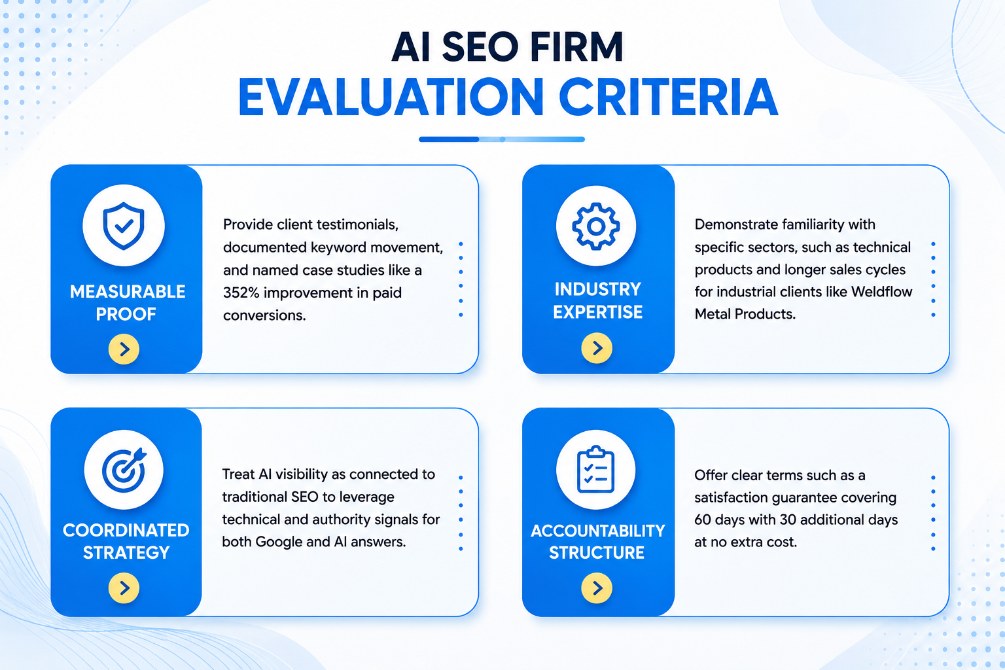
Not all firms claiming AI SEO expertise are equipped to deliver it. A few questions help separate genuine capability from marketing language.
Does the firm show measurable proof of past results, not just general claims? Client testimonials, documented keyword movement, and named case studies carry far more weight than vague promises about “growing your visibility,” the kind of proof we can show you, like the 352% improvement in paid conversions we delivered for one manufacturer.
Does the firm understand your specific industry? B2B and industrial SEO requires familiarity with technical products, longer sales cycles, and buyer roles that don’t exist in consumer marketing, the reason our client Weldflow Metal Products, a Mississauga fabricator, needed a different approach than a consumer e-commerce brand would.
Does the firm treat AI visibility as connected to traditional SEO, rather than a separate add-on service? The strongest results come from treating both as part of one coordinated strategy, since the technical and authority signals that help a site rank in Google also help it get cited in AI answers.
Businesses comparing providers should also understand the differences between an AI SEO agency and a traditional SEO agency, particularly when deciding whether their current strategy adequately covers visibility across Google and AI-generated search experiences.
Does the firm offer any guarantee or accountability structure? A team confident in its process should be willing to stand behind the first stretch of work with clear, stated terms rather than an open-ended commitment, such as the satisfaction guarantee we offer, covering the first 60 days of a program with an additional 30 days included at no extra cost if results aren’t there yet.
We can answer all four of these directly, with specific examples from clients in industries close to your own rather than generic case studies pulled from unrelated sectors. That’s the distinction between a firm that has genuinely rebuilt its process around AI search and one simply attaching the label to an existing service list without changing how the work gets done.
Pricing structures in this space vary widely, and cost alone rarely predicts quality. Some firms bundle AI visibility work into a broader retainer, while others price it as a distinct add-on. What tends to matter more than the pricing model is transparency: a business should be able to see exactly what technical changes, content updates, and monitoring activities are happening each month, rather than receiving a single line item labeled “AI optimization” with no further detail.
Choosing the Right Partner for the Long Term
Selecting a partner for this kind of work is less about finding the lowest price and more about finding a team that understands both the technical mechanics of AI search and the specific language, products, and buyers in your industry.
For companies evaluating digital marketing services in the USA and in Canada, the decision ultimately comes down to a straightforward test: can we show you, with real numbers and real client names, that businesses like yours have been found, cited, and chosen by both traditional search engines and AI platforms. We can pass that test without hesitation, pointing to specific accounts, specific keyword movement, and specific timeframes rather than speaking only in generalities.
As search behavior continues to spread across Google, AI assistants, social platforms, and other discovery channels, a broader search everywhere optimization approach can also help businesses maintain visibility across the different places their buyers research vendors.
We treat the first ninety days as a foundation-setting phase rather than a finished product. Technical fixes, schema implementation, and entity cleanup all need time to be recrawled and reassessed by both traditional search engines and AI models. We set realistic expectations about that timeline while still showing early directional movement in rankings and mentions, which is why clients tend to stay with us for the long run.