

Contact US

The Complete Guide to AI Search Visibility for B2B Brands

AI SEO Snapshot
As AI-powered search reshapes how B2B buyers find vendors, this guide breaks down what AI SEO services actually involve and how they differ from traditional SEO.
We cover the shift toward AI-driven discovery, what’s changed in 2026, the technical foundations that still matter, and how GEO and SAO extend visibility into AI Overviews, ChatGPT, and Perplexity.
The key shift: AI search isn’t replacing your website, it’s becoming the new first touchpoint for B2B buyers. An AI SEO agency that optimizes for both rankings and AI interpretation is essential to stay visible at that touchpoint.
Search has entered a new phase. AI Overviews, ChatGPT, Claude, and Gemini now shape how B2B buyers find vendors before they ever visit a website. For companies offering AI SEO services, this shift means optimization can no longer stop at rankings. It must extend into how AI systems read, interpret, and recommend a brand.
This guide breaks down what AI SEO is, how it differs from traditional SEO, why technical foundations still matter, and how an experienced AI SEO agency builds visibility across both search engines and AI-generated answers. It draws on real strategy work MacRAE’S has applied across industrial and B2B clients throughout 2025 and 2026.
What Is AI SEO and Why Does It Matter Now?
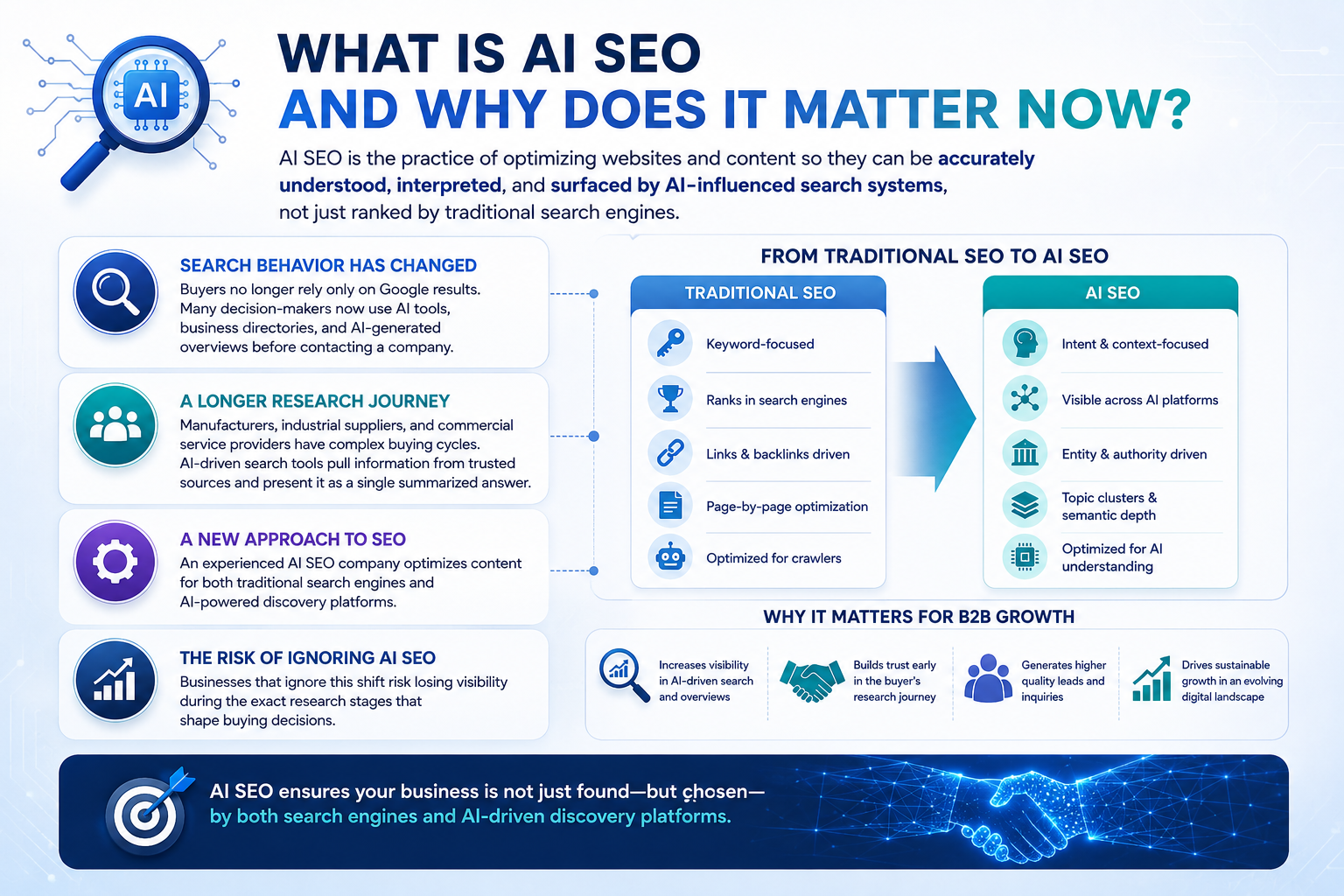
AI SEO is the practice of optimizing websites and content so they can be accurately understood, interpreted, and surfaced by AI-influenced search systems, not just ranked by traditional search engines.
Search behavior has changed rapidly over the last two years. Buyers no longer rely only on Google results to research suppliers. Many decision-makers now use AI tools, business directories, and AI-generated overviews before contacting a company. Rankings still matter, but visibility across AI platforms now plays a larger role in B2B growth.
Manufacturers, industrial suppliers, and commercial service providers feel this shift most. Their buyers run long research cycles before purchasing. AI-driven search tools simplify that process by pulling information from trusted online sources, then presenting it as a single summarized answer.
An experienced AI SEO company now needs to optimize content for both traditional search engines and AI-powered discovery platforms. Businesses that ignore this change risk losing visibility during the exact research stages that shape buying decisions.
How Are AI Tools Changing the Way B2B Buyers Search?
AI-powered search tools deliver direct answers instead of long lists of links. AI Overviews, LLM-powered assistants, and generative search engines gather information from multiple websites to produce a single summarized response.
This changes how content gets discovered. A page that ranks well may still lose visibility if AI systems cannot interpret its information correctly. Several trends now shape B2B search behavior:
- Buyers ask conversational questions instead of typing short keywords
- AI tools prioritize expertise and clear information
- Structured content performs better in AI-generated results
- Topical authority matters more than isolated keyword targeting
- Trust signals influence visibility across AI search platforms
Because of this shift, AI SEO services now focus more on entity optimization, semantic relevance, and structured content development. An experienced SEO agency also works to improve visibility across industry directories and authoritative websites that AI systems frequently reference when building an answer.
Why Does AI Visibility Matter for B2B Growth?
B2B purchasing decisions usually involve multiple stakeholders. Engineers, procurement managers, operations leaders, and executives may all research a company before any conversation begins.
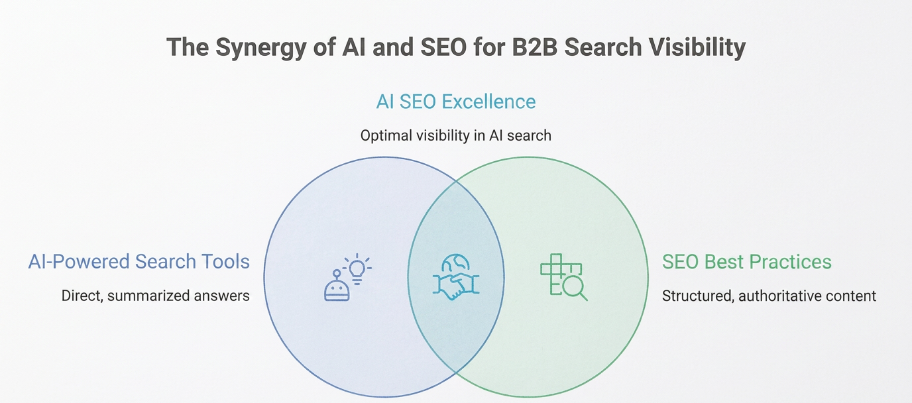
AI-generated search experiences now influence those early research stages. Buyers often review AI summaries before visiting a website directly. Businesses that appear consistently across AI-generated responses gain stronger credibility, which can improve brand awareness, lead quality, website traffic, sales inquiries, and industry authority.
Many industrial companies still rely on outdated SEO methods. They focus only on rankings instead of broader digital visibility. Modern AI SEO services extend beyond Google rankings alone. An AI SEO company that supports AI visibility strategies helps businesses appear across more discovery channels, which creates more opportunities throughout the buyer journey.
In one recent engagement, an industrial manufacturer saw a 146% improvement in organic traffic after restructuring its content and technical foundations, a result that reflects the same principles AI SEO services apply for visibility in AI-driven search.
What Has Changed Between Traditional SEO and LLM SEO?
Traditional SEO has historically focused on optimizing individual web pages for algorithmic ranking signals. Keyword placement, backlinks, metadata, crawlability, and page performance formed the backbone of visibility strategies. Rankings were primarily influenced by how well a page aligned with predefined search queries.
SEO for LLMs operates on a different retrieval model. Large language models interpret intent, synthesize multiple sources, and generate composite answers rather than listing ranked results. Instead of selecting a single page, LLMs assemble responses based on entity recognition, contextual depth, and trust signals distributed across the web.
While traditional SEO optimizes for ranking, LLM SEO optimizes for representation. The goal shifts from appearing at the top of search results to being accurately referenced, summarized, and recommended within AI-generated outputs. This is why an effective AI SEO agency now emphasizes content clarity, semantic structure, and entity authority rather than isolated keyword performance.
The most significant change in traditional SEO and LLM SEO in 2026 is the rise of perception-based visibility. LLMs no longer retrieve information mechanically. They evaluate how a brand is described across multiple sources and how consistently its expertise is reinforced. Perception drift, where AI models gradually misinterpret or dilute brand positioning, has emerged as a measurable visibility risk.
The key shift: the goal is no longer just ranking first. It is being accurately referenced, summarized, and recommended inside AI-generated answers.
What Still Matters from Traditional SEO Foundations?
Despite these changes, several traditional SEO principles remain indispensable. High-quality content, technical accessibility, and authoritative backlinks still influence how LLMs evaluate credibility. AI models are trained on indexed, crawlable content, which makes foundational SEO hygiene non-negotiable.
Structured site architecture, schema markup, and clear internal linking continue to support discoverability. Pages that load efficiently and present information clearly are more likely to be referenced by AI systems. Inconsistent or outdated technical SEO weakens trust signals even in LLM-driven environments.
What has changed is why these elements matter. Traditional SEO focused on rankings. AI SEO services now focus on interpretability. Content must communicate meaning clearly enough for models to extract accurate representations, rather than simply matching keywords.
Traditional optimization and AI SEO are not competing disciplines. Traditional SEO ensures discoverability, technical reliability, and authority. AI SEO ensures that discoverable content is correctly interpreted, accurately summarized, and confidently recommended by AI systems. Sustainable visibility depends on integrating both approaches into one strategy.
How Does Technical SEO Improve Visibility in LLMs?
Search behavior is changing quickly. Buyers now use AI-driven platforms to find answers before visiting websites. Large language models pull information from trusted and optimized sources, which makes technical SEO a major factor in how websites appear in AI-generated responses and AI Overviews.
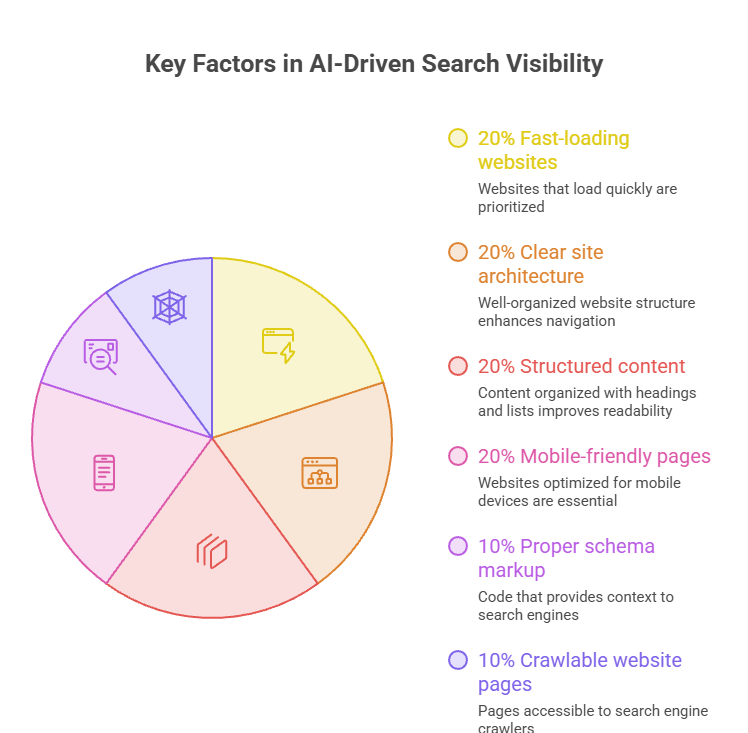
Technical SEO helps search engines and AI platforms access, process, and organize website content. Poor technical structure limits visibility, even with strong written content. AI-driven systems prioritize:
- Fast-loading websites
- Clear site architecture
- Structured content
- Mobile-friendly pages
- Proper schema markup
- Crawlable website pages
These factors help LLMs identify reliable and authoritative information sources. Many companies investing in AI SEO services now focus on technical improvements before expanding content.
How Do Structured Data and Schema Help LLMs?
Structured data helps AI systems identify page topics more accurately. Schema markup adds context to products, services, industries, FAQs, and company details. For B2B brands, schema supports service pages, industry-specific solutions, product descriptions, FAQs, company details, and reviews.
This improves visibility in AI-generated answers and search summaries. Strong schema implementation also supports better indexing for broader AI SEO strategies.
Why Does Website Speed Matter for AI Visibility?
Page speed affects both user experience and AI crawling efficiency. Slow websites often experience weaker indexing and reduced visibility. Technical optimization includes image compression, faster hosting infrastructure, code minimization, browser caching, and reduced server response time. LLMs prioritize websites that deliver information quickly and consistently.
How Does Internal Linking Support AI Discovery?
Internal linking helps AI systems discover relationships between pages and builds topical authority across a website. B2B websites should connect service pages, industry pages, educational blogs, case studies, and resource pages. This creates a clear content hierarchy that helps AI tools recognize expertise within a specific niche.
How Does Crawl Optimization Improve AI Discoverability?
Search bots and AI crawlers need efficient website access. Broken links, duplicate pages, and indexing issues create visibility problems. Technical improvements often include XML sitemap optimization, robots.txt management, canonical tags, fixing crawl errors, removing duplicate content, and improving URL structure. These actions help search engines and AI systems process website content correctly.
What New Techniques Does SEO for LLMs Require?
SEO for LLMs requires techniques that extend beyond page-level optimization. Content must reinforce a stable, machine-readable understanding of a brand’s identity. Key techniques include:
- Entity-first content architecture, defining services, industries, and differentiators in consistent language across all pages
- Narrative cohesion, aligning blogs, service pages, FAQs, and external mentions to reinforce the same positioning
- Contextual depth over breadth, explaining how and why services are delivered, not just what is offered
- Cross-platform consistency, ensuring directories, industry publications, and third-party platforms reflect accurate brand information
AI SEO services increasingly combine content strategy with digital PR, knowledge graph optimization, and authoritative citations. An effective AI SEO company focuses on shaping how AI models synthesize information, not just optimizing isolated ranking signals.
How Does AI Content Marketing Support SEO, PPC, and Multi-Platform Growth?
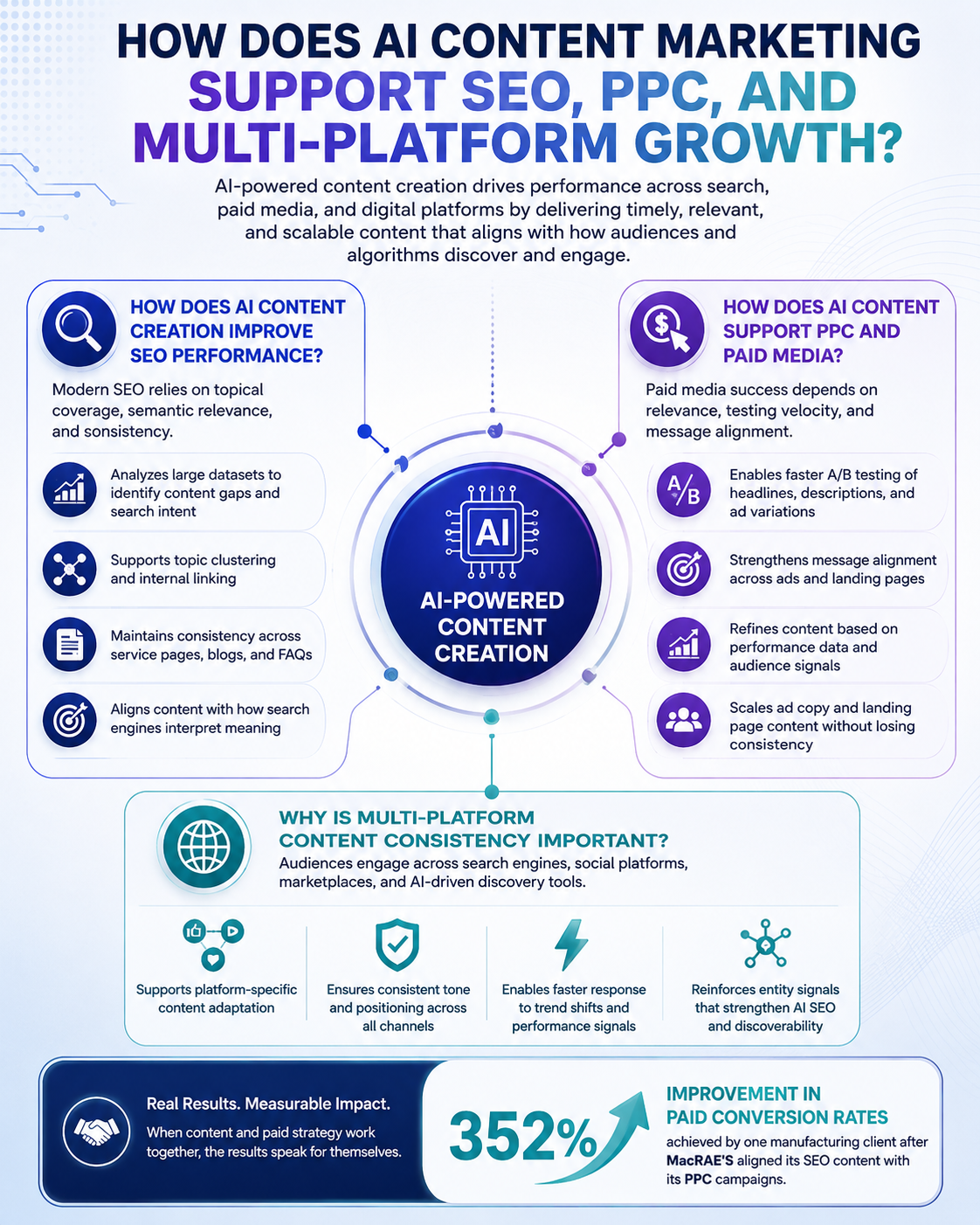
Content strategy has entered a phase where speed, consistency, and intelligence determine performance. AI-powered content creation now plays a direct role in how brands compete across search, paid media, and digital platforms. As algorithms evolve and audiences fragment across channels, content must be timely, data-informed, and adaptable at scale.
This shift has made traditional content workflows harder to sustain. SEO, PPC, and multi-platform distribution now demand continuous optimization and alignment with AI-driven discovery systems.
How Does AI Content Creation Improve SEO Performance?
Search optimization has moved beyond keywords and backlinks. Modern SEO depends on topical coverage, semantic relevance, and consistency across content formats. AI-powered content creation helps teams analyze large datasets, identify gaps, and generate content aligned with how search engines interpret intent. It supports scaling content production without sacrificing structure, supports topic clustering and internal linking, and maintains consistency across service pages, blogs, and FAQs.
How Does AI Content Support PPC and Paid Media?
Paid media performance depends on relevance, testing velocity, and message alignment with audience intent. AI content marketing solutions enable faster A/B testing of headlines and descriptions, stronger message alignment across ads and landing pages, and data-driven refinement based on performance patterns. For businesses managing large ad portfolios, this infrastructure removes manual bottlenecks while keeping messaging consistent with broader AI SEO positioning.
Why Is Multi-Platform Content Consistency Important?
Audiences now engage with brands across search engines, social platforms, marketplaces, and AI-driven discovery tools. Managing content across these channels manually introduces delays and inconsistencies. AI-powered workflows support platform-specific content adaptation, consistent tone and positioning across channels, and faster response to trend shifts and performance signals. This consistency reinforces the entity signals that AI SEO services depend on.
A clear example where, through strategic content optimization and SEO enhancements, Snaile Lockers achieved a 272% increase in organic traffic and a 555% improvement in total conversions.
How Do GEO and SAO Strengthen B2B Brand Authority?
B2B buyers now use AI-driven platforms during vendor research. AI Overviews, LLM tools, and generative search systems influence purchasing decisions earlier in the buying journey. Traditional search rankings still matter, but visibility across AI-generated responses has become equally important.
Generative platforms analyze content quality, expertise, and consistency. They prioritize brands that provide accurate, structured information and evaluate whether content answers real business questions clearly. Several factors influence authority signals:
- Industry-focused content
- Technical SEO structure
- Semantic keyword relevance
- Consistent publishing activity
- Strong backlink profiles
- Clear website architecture
The best AI SEO agencies focus on building these signals over time, helping businesses appear in AI-generated recommendations and search summaries through AI-driven search strategies that build B2B brand authority.
Why Are GEO and SAO Becoming Essential?
Generative Engine Optimization (GEO) and Search Everywhere Optimization (SEO) support visibility beyond traditional search engines. These strategies focus on how businesses appear across AI Overviews, GEO platforms, SAO environments, LLM-generated responses, voice search systems, and industry research tools.
Modern B2B buyers gather information from multiple digital sources before contacting vendors. Businesses with strong GEO and SAO strategies often maintain better visibility throughout this process. Effective AI-focused optimization includes semantic keyword targeting, AI-readable formatting, structured metadata, technical SEO improvements, industry authority building, and high-value educational content.
The key shift: visibility now extends beyond Google. AI Overviews, GEO platforms, and LLM-generated responses are becoming separate channels that require their own optimization, not an afterthought of traditional SEO.
How Do Businesses Build Long-Term Authority in AI Search?
Authority building requires consistency and expertise. AI systems reward businesses that publish accurate, relevant information regularly. Thin or overly promotional content usually performs poorly in AI-generated environments.
Companies should focus on educational content that solves industry-specific problems. Well-structured content increases the likelihood of appearing in AI summaries and conversational search responses. The best AI SEO agencies also focus on user intent and topical depth, which strengthens trust signals across generative platforms.
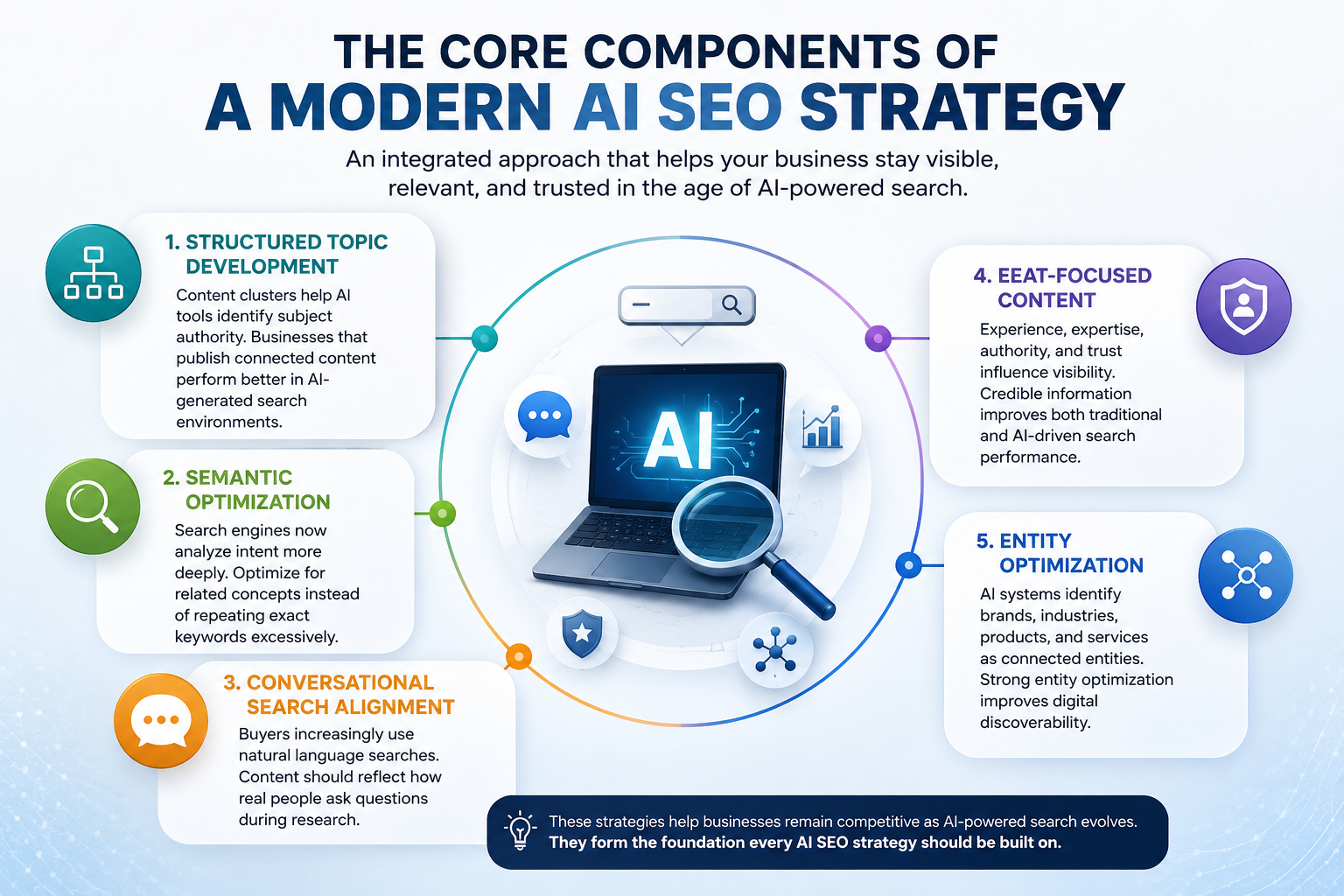
What Are the Core Components of a Modern AI SEO Strategy?
An effective AI SEO strategy brings together several disciplines that used to operate separately. Based on the practical optimization work behind AI SEO services, the core components include:
- Structured Topic Development. Content clusters help AI tools identify subject authority. Businesses that publish connected content perform better in AI-generated search environments.
- Semantic Optimization. Search engines now analyze intent more deeply. An AI SEO agency must optimize for related concepts instead of repeating exact keywords excessively.
- Conversational Search Alignment. Buyers increasingly use natural language searches. Content should reflect how real people ask questions during research.
- EEAT-Focused Content. Experience, expertise, authority, and trust influence visibility. Credible information improves both traditional and AI-driven search performance.
- Entity Optimization. AI systems identify brands, industries, products, and services as connected entities. Strong entity optimization improves digital discoverability.
These strategies help businesses remain competitive as AI-powered search continues to evolve, and they form the foundation that any AI SEO company should build on before adding tactics on top.
How Can B2B Companies Transition from Traditional SEO to AI SEO?
Transitioning to AI SEO does not require abandoning traditional SEO efforts. Instead, it involves layering new optimization priorities on top of existing foundations. Practical steps include:
- Audit brand representation. Review how AI platforms describe services, industries, and competitive positioning. Identify gaps, inaccuracies, or omissions.
- Standardize entity language. Align terminology across web pages, case studies, and external profiles to reduce ambiguity in AI interpretation.
- Restructure content for clarity. Organize pages around clear thematic sections rather than keyword clusters. Logical structure improves AI comprehension.
- Strengthen authoritative references. Secure mentions from trusted industry sources that reinforce expertise and credibility.
- Monitor AI-generated outputs. Regularly evaluate how LLMs summarize the brand and adjust content to correct perception drift.
An experienced AI SEO agency supports this transition by combining technical SEO expertise with an AI visibility strategy, rather than treating it as a one-time project.
Why Are Manufacturing and Industrial Businesses Investing More in AI SEO Services?
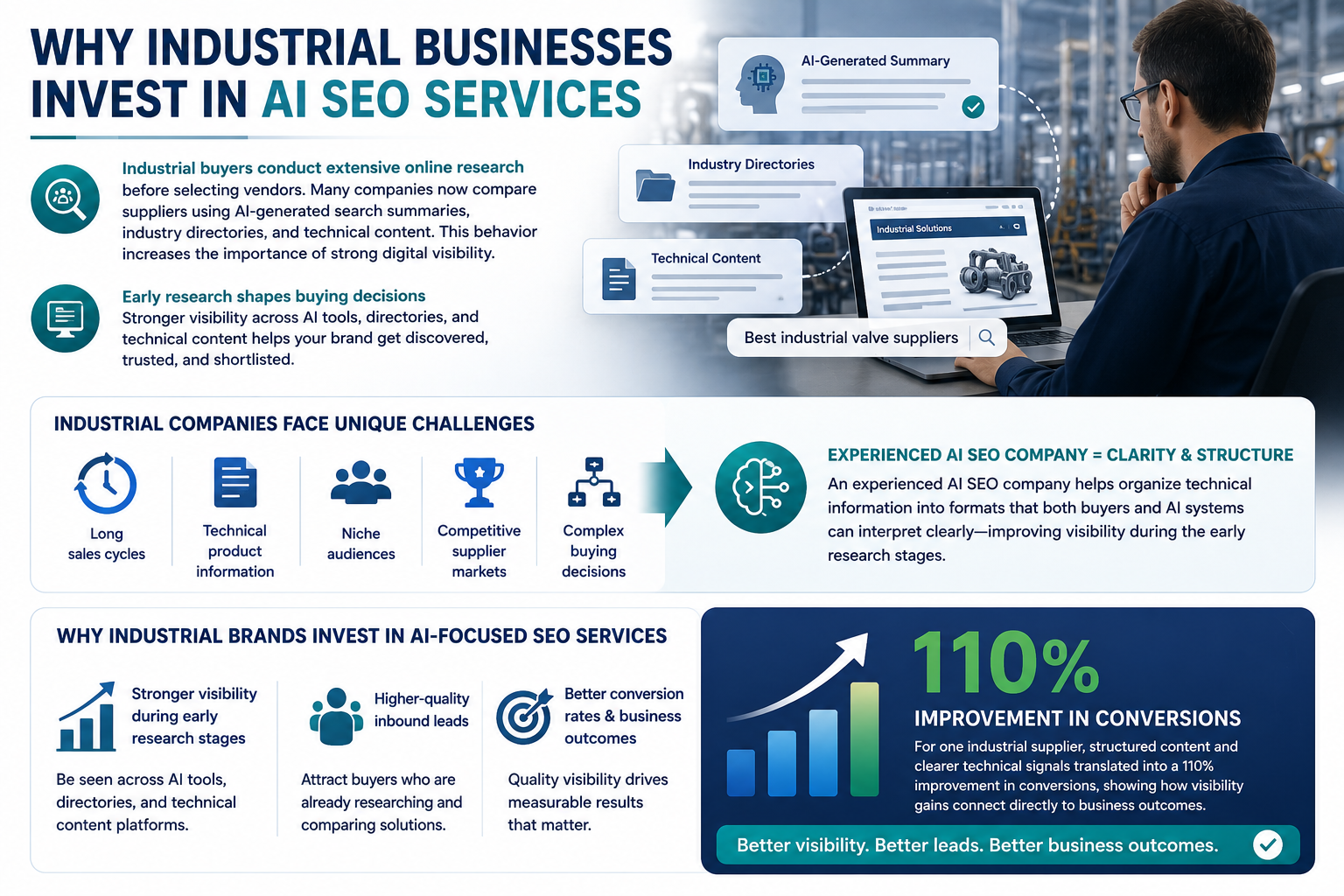
Industrial buyers conduct extensive online research before selecting vendors. Many companies now compare suppliers using AI-generated search summaries, industry directories, and technical content. This behavior increases the importance of strong digital visibility.
Industrial companies also face specific challenges: long sales cycles, technical product information, niche audiences, competitive supplier markets, and complex buying decisions. An experienced AI SEO company helps organize technical information into formats that both buyers and AI systems can interpret clearly.
Many industrial brands now invest in AI-focused SEO services because they want stronger visibility during early research stages. Better visibility often leads to higher-quality inbound leads, which is the outcome that ultimately matters more than rankings alone.
For one industrial supplier, structured content and clearer technical signals translated into a 110% improvement in conversions, showing how visibility gains connect directly to business outcomes.
How Should B2B Companies Prepare for the Future of AI Search?
Between 2026 and 2028, SEO is expected to become increasingly perception-driven. Ranking positions will matter less than whether a brand is included and accurately represented within AI-generated answers. Several trends are emerging:
- AI systems will rely more heavily on entity trust scores rather than link volume alone
- Multi-platform visibility will outweigh single-channel optimization
- Brands with consistent narratives will outperform those relying on fragmented content strategies
AI SEO services will evolve into an ongoing governance function, ensuring AI systems continue to reflect accurate business positioning as models retrain and data sources expand. An AI SEO agency will increasingly serve as a long-term partner rather than a campaign-based vendor.
Practical steps that support long-term visibility include publishing expert-driven content regularly, improving technical website performance, organizing content into topic clusters, maintaining consistent business information, focusing on user intent instead of keyword stuffing, developing content for conversational searches, and building authority within specific industries.
AI-driven search is not replacing SEO. It is reshaping how search visibility works across the digital landscape, and businesses that adapt early gain a real competitive advantage.
Why Choose MacRAE’S as Your AI SEO Company
MacRAE’S delivers AI SEO services built specifically for industrial and technical B2B environments, where clarity, accuracy, and authority matter more than volume. As an established AI SEO agency, MacRAE’S combines AI-ready content structuring, semantic and entity optimization, technical SEO for AI interpretation, authority and trust reinforcement, and alignment with evolving search interfaces, including AI-generated summaries and enhanced search results.
All AI SEO strategies are validated internally through platforms such as Scott’s Directories and Canadian Trade Index before being implemented for clients. The focus stays on accuracy, authority, and long-term performance, not short-term tactics.
Search visibility is no longer defined solely by rankings. It is defined by how clearly content can be understood, trusted, and surfaced by intelligent systems. MacRAE’S helps industrial B2B companies adapt to AI-driven search by ensuring content is structured, contextual, and ready for evolving search experiences.
Book a strategy session with MacRAE’S to assess your current search readiness, identify AI-related visibility gaps, and build an AI SEO strategy designed for long-term competitiveness.