
Contact US

10 Best AI SEO Agencies in the USA
 The person you have your best chance with has asked ChatGPT which company they should buy from and it has provided them with three names. You will never know if yours was one of those.
The strange thing about search at the moment is that there is no impression count for the shortlist you didn’t create, no warning sign in the analytics, and no ranking report stating that you were omitted from that answer; the outcome just simply takes place somewhere else.
It was due to this gap that AI SEO Services changed from being a specialist extra to becoming a standard budget option within about two years, and it is also the reason why almost every agency in the country now has a page dedicated to it. The difficult part, though, is distinguishing between those that have a working method and those that have only a new headline.
So, we narrowed it down to ten firms in the USA doing this work in public, with published research, named frameworks, or client work you can actually go and read.
People Also Ask
Can AI SEO work without a big content budget?
Yes, to a point. Early gains often come from fixing structure, schema, and existing pages rather than publishing anything new.
Do AI tools cite my own website or other sites?
Mostly other sites. Generative engines lean heavily on third-party pages, roundups, and directories, so earned mentions matter as much as your own content.
First, the numbers that changed the conversation
None of this is theory. The click economy that SEO was built on has been shifting for a while, and the data is fairly consistent across independent trackers.
| US Google searches ending without a click | 58.5% | SparkToro and Datos, 2024 zero-click study |
| Share of all Google searches ending without a click, 2026 | 68% | Similarweb clickstream panel, June 2026 |
| Zero-click rate when an AI Overview appears, vs when it does not | 83% vs 60% | Similarweb |
| Click drop on the top organic result when an AI Overview appears | 58% | Ahrefs, analysis of 300,000 keywords |
| Click-through with an AI Overview present vs absent | 8% vs 15% | Pew Research Center |
| CTR change on branded queries with an AI Overview | +18.68% | Amsive, study of 700,000 keywords |
| CTR change on non-branded queries with an AI Overview | -19.98% | Amsive |
Read the last two rows together, and the picture gets interesting. Brands people already know keep their clicks and sometimes gain a few. Everyone else absorbs the loss. That single split explains most of what good AI-based SEO Services are actually trying to fix.
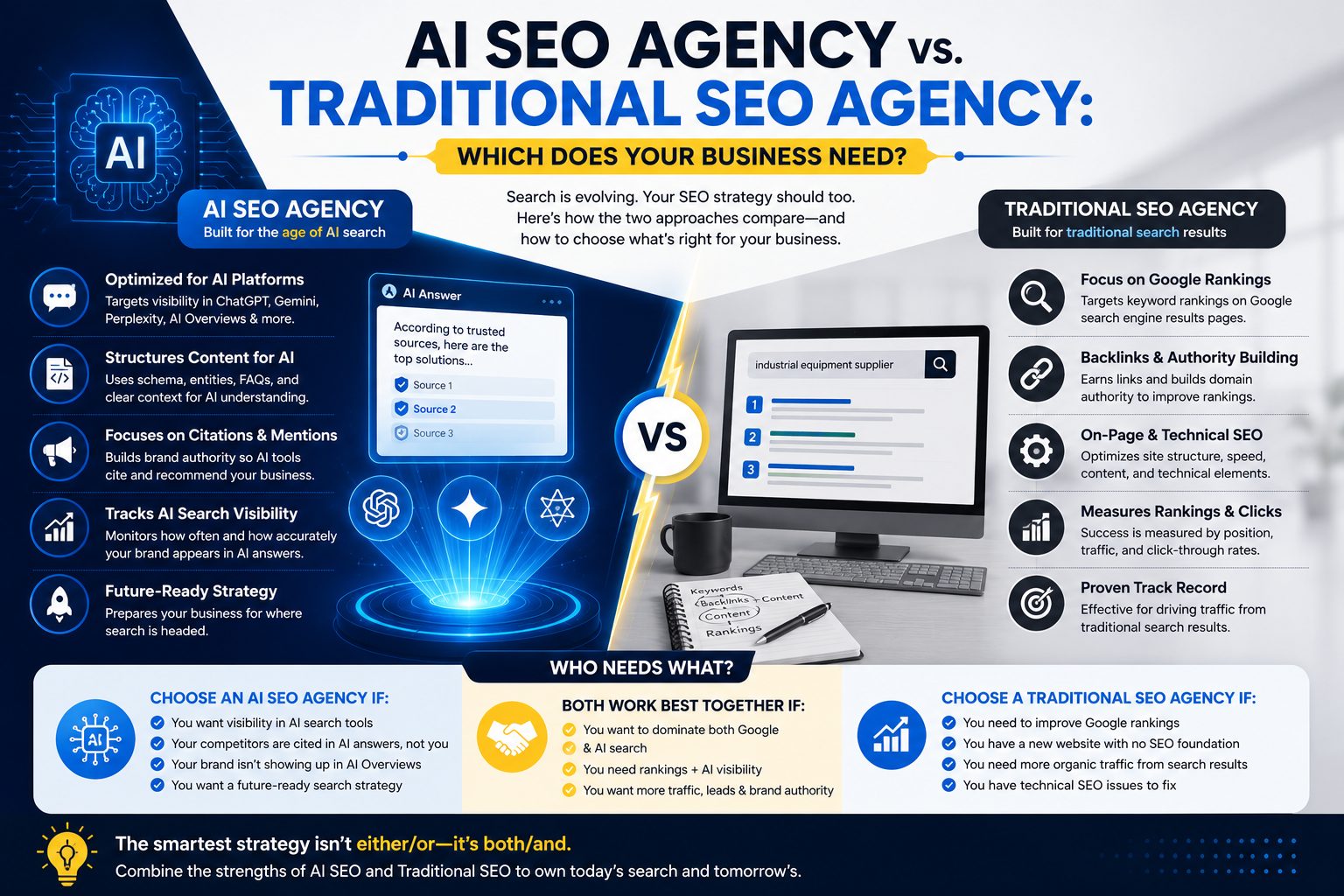
What “AI SEO” Means Once You Strip Out the Acronyms
The vocabulary is a mess right now, so here is the short version.
SEO is still ranking on Google and Bing. Technical health, crawlability, content that matches intent, links. None of it went away.
AEO, answer engine optimization, is about being the answer that gets pulled to the top. Featured snippets, AI Overviews, voice results. Schema, structured data, and content formatted so a machine can lift it cleanly.
GEO, generative engine optimization, is about being cited inside a generated answer on ChatGPT, Perplexity, Gemini, or Copilot. That leans on authority, topical depth, and third-party mentions more than on-page work.
AI SEO is the umbrella most agencies use for all three. Some also use the terms LLM SEO or Search Everywhere Optimization. Different labels, broadly the same job.
One thing gets lost in the acronym soup: these strategies don’t compete. Research from Grow and Convert found a 72% correlation between first-page rankings and mentions in AI tools, which suggests the two surfaces feed each other rather than replace each other.
10 Agencies to Consider for AI Based SEO Services in the USA
| MacRAE’S | Mississauga, serving the US and Canada | AI visibility for B2B, industrial, manufacturing | Manufacturers and industrial suppliers |
| iPullRank | New York, NY | Relevance Engineering, technical AI search | Enterprise and Fortune 500 teams |
| Seer Interactive | Philadelphia, PA | Data-led search, published AI research | Large in-house teams that want evidence |
| Siege Media | San Diego, CA | Content, digital PR, GEO frameworks | SaaS and ecommerce scaling content |
| First Page Sage | San Francisco Bay Area, CA | Thought leadership content, GEO research | Long-cycle B2B and professional services |
| Omniscient Digital | Austin, TX | B2B SaaS content and organic growth | Software companies with product-led motion |
| Single Grain | Los Angeles, CA | Full-funnel organic and paid, GEO audits | Brands wanting search and paid in one place |
| Victorious | San Francisco, CA | SEO and AEO as one program | Mid-market and enterprise organic search |
| Amsive | New York, NY | Performance marketing plus AEO | Regulated sectors like finance and healthcare |
| Intero Digital | Colorado Springs, CO | GEO through the Intero GRO system | Multi-location and national brands |
1. MacRAE’S
Industrial search is its own animal, and MacRAE’S has stayed inside it rather than spreading across every vertical. Engineers, plant managers, and procurement teams do not research like consumers. They compare spec sheets, check certifications, and shortlist quietly, often without filling in a form. MacRAE’S has built its AI-Powered SEO Services around that behaviour rather than adapting a B2C playbook.
The framework it uses is called the AI Visibility Engine. Instead of treating Google as the finish line, it maps where a business is missing across Google, ChatGPT, Bing, Perplexity, LinkedIn, industry directories, and voice search tools, then works on the pages and listings that sit closest to a quote request. The company groups this under Search Everywhere Optimization.
Their services include AI SEO Services, GEO, AEO, LLM SEO, AI-powered content creation, technical SEO, web development, and B2B lead systems. MacRAE’S is a certified Google Partner and publishes a satisfaction guarantee.
Good fit if: you sell industrial equipment, components, packaging, logistics, or B2B services, and your buyers ask AI tools who to trust before they ask you.
2. iPullRank
Mike King has spent the last two years pulling apart how AI search actually retrieves and assembles answers, and iPullRank has built a practice around it. The agency calls the discipline Relevance Engineering, and it goes deeper into the machinery than most: query fan-out, passage retrieval, embeddings, and synthesis.
King was named Search Engine Land’s Search Marketer of the Year. He also built the Qforia tool and founded the SEO Week conference in New York. The agency works with brands including SAP, American Express, and HSBC.
Good fit if: you have a large site, an in-house search team, and questions that need an answer grounded in how retrieval works rather than a best-practice checklist.
3. Seer Interactive
Seer has been running since 2002 out of Philadelphia, is a certified B Corporation, and has grown to more than 250 people. What sets it apart in the AI conversation is its output. The team has been publishing AI studies since January 2023, and that research gets cited by Forbes, eMarketer, Fast Company, Semrush, Search Engine Land, and Ahrefs.
Its AI Overviews CTR study is one of the datasets other agencies quote when they explain what changed. Seer also promoted Alisa Scharf to Chief AI Officer, which suggests the function isn’t bolted on.
Good fit if: you need a partner who shows their work, and your internal team wants data before it commits a budget.
4. Siege Media
Ross Hudgens founded Siege in August 2012, and it has made the Inc. 5000 six years running. The team has over 100 people in San Diego and works across SEO content, digital PR, design, and technical work for brands like Asana, Intuit, Casper, and Zapier.
Siege leans on content and earned coverage, which aligns with how generative engines pick sources. The agency builds scalable GEO frameworks for AI-driven environments like ChatGPT, Gemini, and Perplexity, and Hudgens has a book on generative engine optimization published with Wiley in late 2026.
Good fit if: content is already your main acquisition channel and you want the AI layer built on top of it rather than beside it.
5. First Page Sage
Founded in 2009 by Evan Bailyn, First Page Sage is one of the longer-running firms doing this work, and it moved early. The agency began offering GEO as a named service in early 2023 and has published extensive original research since, including a study of more than 30,000 ChatGPT queries analyzing purchase-intent citations.
The model is thought leadership first. Deep, specialist-written content built to become the source AI tools return to, plus the technical work underneath. Its published case studies include a 934% keyword ranking increase for Cadence Design Systems.
Good fit if: your category rewards depth, your sales cycle runs long, and being the reference everyone quotes is worth more than raw traffic.
6. Omniscient Digital
Omniscient was founded in 2019 and is based in Austin, Texas, and was started by former growth leaders from HubSpot and Shopify. The B2B software focus has stayed narrow ever since.
Its Surround Sound approach focuses on being mentioned favourably across top resources so large language models pick it up. Content strategy gets mapped to product workflows rather than keyword volume, with attribution models that track organic contribution to recurring revenue.
Good fit if: you are a software company with an existing content engine and you want organic work tied to signups instead of sessions.
7. Single Grain
Eric Siu’s agency has been running since 2009 out of Los Angeles and covers more ground than most on this list: SEO, GEO, paid media, content, and conversion work under one roof. Clients have included Amazon, Uber, and Salesforce.
On the AI side, Single Grain runs GEO audits that show how generative engines read a brand’s content, then works on entity mapping and cross-platform consistency so the picture holds up across Google’s AI Overviews, ChatGPT, and other AI systems. Siu also co-hosts the Marketing School podcast with Neil Patel.
Good fit if: you want organic and paid campaign management together, with AI visibility layered across both.
8. Victorious
Victorious has been going since 2013 out of San Francisco, has served 600-plus brands, and holds five SEO Agency of the Year wins across Search Engine Land, the US Search Awards, and Clutch. Past clients include Salesforce, SoFi, Wayfair, and Delta Dental.
AEO is not a separate product. The same entity-authority foundation that drives search performance also determines citation eligibility in Google AI Overviews, ChatGPT, Perplexity, Gemini, and Copilot, so both run as one program. Victorious also publishes a Quarterly Search Report tracking how brands appear.
Good fit if: you want a search-only partner rather than a generalist, and you would rather not manage AEO as a separate contract.
9. Amsive
Amsive has been in performance marketing since 2005 and is based in New York. It formally added Answer Engine Optimization to its SEO offering in June 2025, working alongside the AI visibility platform Profound, and its SEO work spans healthcare, financial services, ecommerce, and B2B.
Its CTR study analyzed 700,000 keywords across 10 websites in five industries and produced a branded-versus-non-branded split that reframed how many teams think about the problem. The Drum Awards, the US Search Awards, and the Search Engine Land Awards have recognized the agency.
Good fit if: you operate somewhere with compliance overhead and you want a partner used to that scrutiny.
10. Intero Digital
Intero has been around since 1996, runs 201 to 500 employees from Colorado Springs, and has locations across the US. Its GEO work runs through a system it calls Intero GRO, which shapes content, structured data, brand mentions, and media to perform across AI assistants like ChatGPT, Gemini, and Copilot.
The rest of the offering is broad: entity-based content strategy, technical SEO, digital PR, multimedia asset development, national and local SEO, web design and development, and paid media.
Good fit if: you have multiple locations or a national footprint and want AI visibility handled alongside everything else.
What to Ask Before You Sign an AI SEO Agency in the USA?
Most agency calls sound the same. These questions tend to separate them.
- Show me a brand you moved into AI answers. Not traffic, not rankings. A prompt, a before, an after.
- How will you measure this? Ask which tool, how often, and across which platforms. Citation tracking is not the same as rank tracking.
- What happens to my content? GEO leans on structure, direct answers, and comparison formats. Find out who does the rewriting.
- Where will the third-party mentions come from? Generative engines lean heavily on earned sources. Ask how those are earned.
- Who is actually on my account? The person on the pitch is not always the person doing the work.
- What does month one to month three look like? Vague timelines usually mean a vague plan.
One last thing to check is whether the agency understands your buyer. AI-powered SEO Services for a DTC skincare brand and a metal fabrication shop share a toolkit and almost nothing else.
Where to go from here
There is no single best agency here, only a best fit. Enterprise teams with in-house search people want something different from a manufacturer with one marketing manager and a quote form.
Before you shortlist anyone, run the test yourself. Open ChatGPT, Perplexity, and Google AI Mode. Ask the questions your buyers ask. Write down which names come back.
Whatever you find is your actual starting line, and it is a far more useful brief than any agency pitch.
Frequently asked questions
How long before anything shows up in AI answers?
Is traditional SEO finished?
Is a separate agency needed for GEO?
How can I tell whether my brand is not visible in AI search?