
Contact US

Top 10 Generative Engine Optimization (GEO) Agencies in Canada (2026)
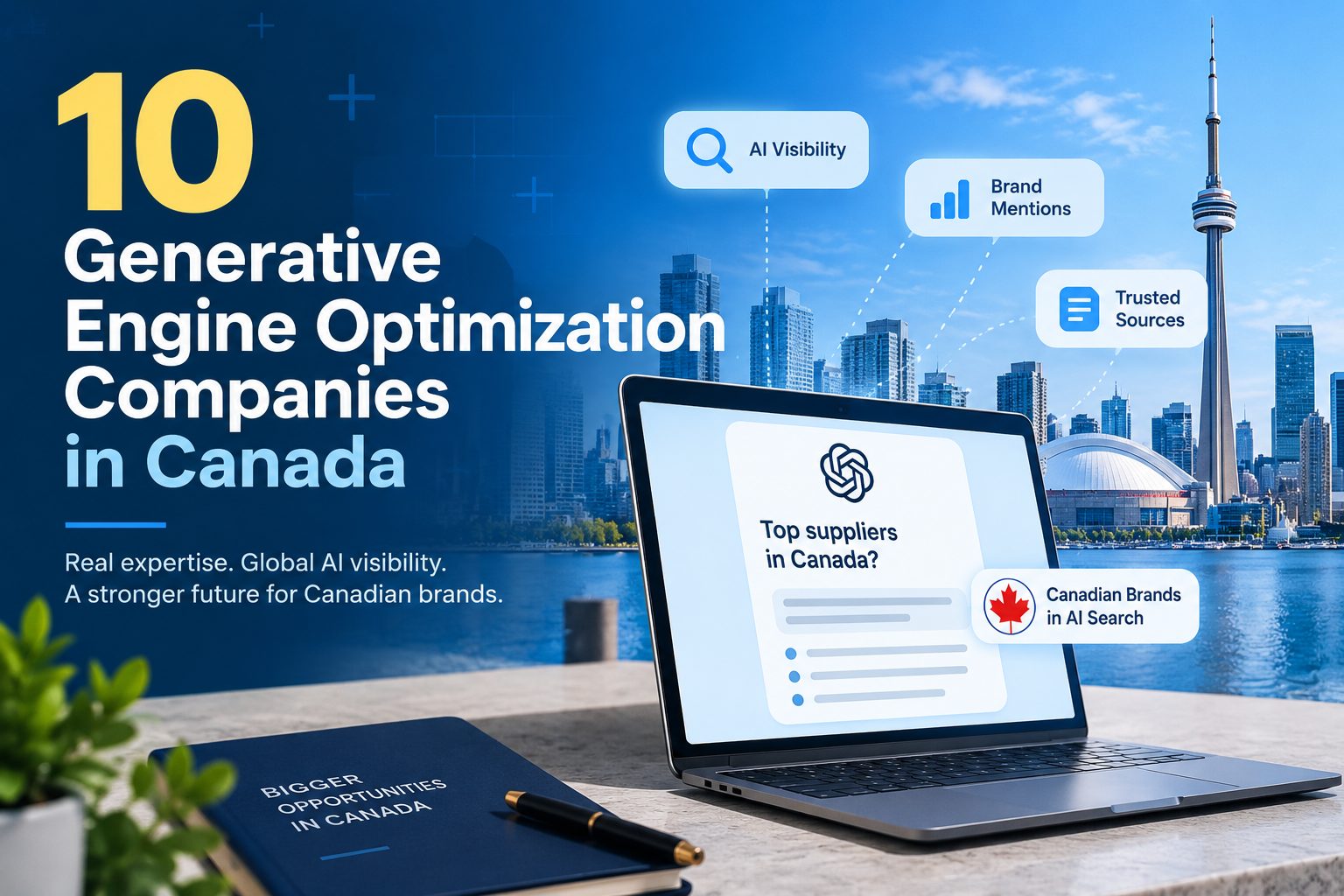 Try something before you read any further.
Open ChatGPT and enter your category followed by ‘in Canada ‘, for example ‘best commercial HVAC suppliers in Canada’ or ‘top payroll software for Canadian small business’.
Carefully read the answer. Are you involved in it? Are your competitors? Is there anyone in it who shouldn’t be?
Canadian marketers who run that test usually feel a bit unsettled. In some cases, the brand is completely missing. In others, it is present but stated incorrectly. And quite frequently the list contains a large number of American companies which do not serve that market.
The most painful of all those points is the very reason why so many Canadian teams have begun looking into generative engine optimization services in Canada over the past year.
People Also Ask
Should I Hire a Canadian GEO Agency or a US One?
A Canadian team helps when French coverage, local search intent, or Canadian buyer context matter; otherwise either can do the work.
Why Do American Companies Show Up When I Search for Canadian Suppliers in AI Tools?
US brands often have deeper citation footprints online, so AI systems surface them even for queries specifying Canada.
Canada’s Version of This Problem Has Its Own Wrinkles
The change is worldwide: since AI tools now provide answers rather than a list of links, brands have to win a spot within those answers. That’s fine; everyone is facing this issue.
However, several factors make the Canadian situation genuinely different.
Canadian consumers got on board with the tools more quickly than Canadian businesses did. According to Attest’s 2025 Consumer Adoption of AI report, 56% of Canadians had used ChatGPT, compared with 45% in the corresponding US figure. On the other hand, Statistics Canada’s Canadian Survey on Business Conditions showed that the level of AI adoption among established businesses was 19.2% in the second quarter of 2026; this is three times the 6.1% recorded in the second quarter of 2024, and still indicates that four out of five businesses have not adopted it.
Your customers are already doing research this way, while your industry probably isn’t.
Adoption varies extremely from sector to sector. According to Statistics Canada’s figures for the second quarter of 2026, the information and cultural industries have a rate of 42.3%, finance and insurance 40.4%, and professional, scientific and technical services 32.4%. On the other hand, construction is at 9.2%, wholesale trade at 7.9%, and agriculture at 4.5%. So, if you are selling to those lower sectors, you will find a vast range of opportunities.
The volume is concentrated in one location. According to the Canadian AI Search Index, there were approximately 27.4 million combined monthly searches across the major AI assistants in Canada by the third quarter of 2026, of which ChatGPT accounted for about 24.9 million. That means almost 91% of the tracked volume is on one platform.
There’s also the matter of language, and I’ll talk about it shortly since it warrants its own section.
The Bilingual Gap Nobody Planned For
There’s an aspect which has no counterpart in America.
Google introduced AI Overviews in Canada on October 28, 2024, and made them available in English, Hindi, Indonesian, Japanese, Portuguese, and Spanish; French was not included at that time. AI Mode, the standalone conversational feature, was made available in Canada on August 21, 2025, starting with English, and received French support globally on October 6, 2025.
Read it again, since timing matters: French support has been rolling out one feature at a time rather than all at once, and the most visible surface has been the one that has taken the longest to catch up.
For a brand that targets Quebec, this situation is rather unusual. The French version of the site doesn’t use the same AI systems as the English version. Moreover, simply translating the content isn’t enough to bridge the gap, because Quebec’s Bill 96, which modifies the Charter of the French Language, includes its own requirements for commercial communications.
Ask any agency you have shortlisted how they handle French. If the response is “we translate the English version”, then continue looking.
The Ten Agencies for Generative Engine Optimization at a Glance
| Agency | Home Base | Where They’re Strongest | Best Suited To |
|---|---|---|---|
| MacRAE’S | Mississauga, ON | Industrial and technical B2B accuracy in AI answers | Manufacturers, suppliers, engineering firms |
| Major Tom | Toronto, Vancouver, New York | Integrated brand, paid, SEO and GEO at scale | Larger brands selling on both sides of the border |
| Search Engine People | Pickering / Toronto, ON | Two decades of search depth applied to AI citations | SMBs and mid market building AI visibility gradually |
| seoplus+ | Ottawa, ON | GEO plus AI Overview optimization, with bilingual coverage | National brands needing English and French |
| Konstruct Digital | Calgary, AB | B2B and industrial demand across long buying cycles | SaaS, professional services, industrial suppliers |
| Parachute Design Group | Toronto, ON | Schema, semantic HTML and AI ready site architecture | Organizations whose website is the bottleneck |
| dNOVO Group | Toronto, Ottawa, Calgary | Regulated verticals where accuracy is non negotiable | Legal, medical and professional practices |
| My Little Big Web | Montreal, QC | French language and bilingual visibility | Quebec based and Quebec facing brands |
| Digital 6ix | Toronto, ON | AI visibility audits for smaller budgets | SMBs testing the water before committing |
| Top Draw | Edmonton, AB | Technical search plus creative for large institutions | Western Canadian enterprise and public sector |
1. MacRAE’S: For Industrial B2B, It Is the Company Where It Is All About Being Described Accurately
If you ask an AI tool to produce a summary of a metal fabricator, a packaging manufacturer, or an industrial distributor, it will generally get the general outline correct but miss the details. Tolerances will disappear. Certifications will disappear. The single capability that actually secures the contract will vanish.
How the work breaks down:
- Defining your entities, so AI systems can tell what your business actually does.
- Restructuring content for summarization and comparison, not just ranking.
- Aligning how you’re described across your site, directories and industry platforms
- Strengthening the authority signals generative engines lean on
- Watching how the answers change over time, and correcting drift
MacRAE’S has more than 25 years’ experience in digital marketing, is an ama certified Google Partner, and headquarter in Mississauga, with coverage across locations ranging from Toronto and Ottawa to Calgary and Vancouver. They test geo strategies on their own Canadian property sites, Scott’s Directories, and the Canadian Trade Index before implementing them in the clients’ programmes. A realistic time frame before there is a meaningful shift in visibility and accuracy is three to six months.
Suitable for: companies that make things and technical business to business organizations offering complex products and having long sales cycles.
2. Major Tom: Regarding Brands That Operate on Both Sides of the Border
Major Tom was formed by the merger of 6S Marketing and Drive Digital and has about 85 specialists based in Toronto, Vancouver and New York; some of their clients have been HSBC, Cirque du Soleil, Expedia and 1-800-GOT-JUNK?
They were among the first Canadian full service agencies to promote GEO and AEO side by side with SEO, rather than quietly adding them. This cross border presence matters more than it may seem, since a Canadian brand entering the US market has to battle for space among answers where its American competitors are already established.
The disadvantage of using a full service shop is that it can lead to a lack of depth. If you have a wide range of brands and include both paid and creative services, then your expertise in the area of hard AI visibility measurement becomes more general.
Suitable for: large organizations that want a single team covering brand, media, and search.
3. Search Engine People: For Steady, Unflashy Visibility Building
SEP was established just at the start of the millennium and has its head office in Pickering with a presence in Toronto; it has about 25 years’ experience in the field, having worked on accounts such as those of Cineplex and Whirlpool.
Longevity matters here; an agency that has adapted to Panda, Penguin, the mobile first update, and helpful content updates has developed an instinct for sudden platform changes. Their work in the geo markets is based on a data driven, semantically structured content strategy rather than gimmicky tactics.
They also provide free first audits, which makes them a low friction option for finding out where you really are.
Suitable for: small and mid sized businesses that wish to build up their AI visibility gradually.
4. seoplus+: For National Brands Which Need to Operate in Two Languages
It is headquartered in Ottawa and has been operating for over ten years; seoplus+ is in Google’s highest partner tier and provides services for Ottawa, Toronto, Vancouver and for clients in Canada and the United States.
They divide AI work into three parts: SEO, AIO (AI Overview optimization) and GEO, a breakdown that is more truthful than most. The GEO program includes AI audits, topic research, competitive analysis, content optimization and digital PR aimed at building authority.
Because of the bilingual coverage mentioned earlier, the French capability brings a real practical benefit, not merely a point on their capabilities list.
Best for: national brands that serve both English and French speaking Canada.
5. Konstruct Digital: For B2B and Industrial Pipelines
Like a B2B agency ought to, Konstruct, based in Calgary, tackles GEO by first examining the brand’s existing authority on AI search platforms and then enhancing it through reviews, directories, outreach, and content distribution, all of which are measured.
Their content approach focuses on establishing authority in a particular category rather than traffic volume, which suits businesses where a single closed deal can cover a full year of search advertising. They have provided their services to SaaS companies, professional services firms, industrial suppliers and B2B ecommerce brands.
Suitable for: B2B companies that have lengthy buying processes involving multiple stakeholders.
6. Parachute Design Group: In the Situation Where the Website Itself Is the Problem
Parachute, set up in 2003 and based in Toronto, combines custom WordPress development with AI search optimization; this combination matters more than it may at first appear, since many AI visibility failures are structural rather than editorial.
The work includes JSON LD schema, semantic HTML5, a site architecture that enables the parsing of content hierarchy, Core Web Vitals, and conversion rate optimization, all of which are supervised by seniors. Choose this profile if your content is good, but your platform is ten years old.
The quoted price is about CA$2,500 per month for AI search optimization alone, while custom development projects begin at nearly CA$40,000.
Right fit for: organizations whose technical foundation needs rebuilding before optimization can stick.
7. dNOVO Group: For Regulated Professions
With offices in Toronto, Ottawa and Calgary, dNOVO has built its reputation in legal, medical and other regulated verticals, combining SEO with GEO for AI search.
Regulated content is its own discipline. Compliance language, professional advertising rules and accuracy requirements all constrain what you can say, and AI systems summarizing that content introduce a fresh risk of misstatement. An agency that already works inside those constraints starts several steps ahead.
Right fit for: law firms, clinics and professional practices where an inaccurate AI summary carries real consequences.
8. My Little Big Web: For Quebec and French First Visibility
Montreal based with over a decade behind them, My Little Big Web works on visibility across Google and generative platforms including ChatGPT, Perplexity and AI Overviews, alongside Google Ads and web builds.
For any brand where French search is core rather than secondary, a Quebec based team is worth shortlisting specifically. Not because English agencies can’t translate, but because search intent, phrasing and cultural reference points in Quebec French don’t map cleanly from English.
Right fit for: Quebec based businesses and national brands where francophone customers are a primary audience.
9. Digital 6ix: For Smaller Budgets That Still Need a Real Answer
Toronto based and built for small and medium businesses, Digital 6ix runs a dedicated GEO service alongside traditional SEO.
Their starting point is an AI Visibility Audit, a diagnostic of where a business currently stands across ChatGPT, Google AI Overviews, Perplexity and Claude. From there, they build a roadmap that closes ranking gaps and citation gaps at the same time rather than treating them as separate projects.
Starting with a diagnostic is a sensible way to spend a modest budget. You find out whether you have a content problem, a technical problem or an authority problem before committing to a retainer.
Right fit for: SMBs that want a clear baseline before they invest further.
10. Top Draw: For Western Canadian Institutions
Edmonton based and operating since 1993, Top Draw combines technical search work with award winning creative capability, serving Western Canadian enterprises and public sector organizations.
Public sector and large institutional clients bring requirements most agencies rarely encounter, accessibility compliance, procurement processes, multi stakeholder approvals. An agency fluent in that environment saves months of friction.
Right fit for: enterprises, universities and public bodies in Western Canada.
A few others turn up regularly in Canadian GEO shortlists depending on your niche, including Azuro Digital, Green Lotus, Rivetline and GrowME Marketing. Worth a look if none of the ten above match your situation.
What Is GEO?
SEO aims to secure a position on the results page, while GEO aims to secure a line within the answer.
Four practical consequences follow from that:
- Passages get retrieved, not pages. A 4,000 word masterpiece can be skipped entirely if no self contained chunk of it answers the question.
- Figures combined with specific sources are better than adjectives. The phrase “industry leading” gives the language model no information, whereas “ISO 9001 certified, 48 hour turnaround, 12 Canadian distribution points” tells it a great deal.
- Consistency across the web does most of the work. If you describe yourself in three different ways on your website, your Google Business Profile and your listing in the industry directory, then you make it more difficult to summarize yourself.
- Accuracy became a metric, since a mistake could cost you more than not mentioning something.
This doesn’t mean that SEO is any less important. Generative systems still crawl, still take authority into account, and still need something credible to base their output on. Anyone who says that SEO is obsolete is describing a system that has not yet come into being.
How to Choose a Generative Engine Optimization Company?
Four questions do most of the filtering.
Which prompts will you track for us, and how did you choose them? The way you select prompts will quietly determine exactly what you’ll see in the reports six months from now, and a vague answer at this stage will result in vague reports later on.
Give me an example of a report in which the figures went the wrong way. Every honest program will have at least one. Agency reports that fail to include such an example are either because the agency hasn’t been operating long enough or because they’re not giving you all the information.
What approach do you take regarding French? Even if Quebec isn’t your target market right now. The way you answer shows how thoroughly they’ve studied the platform landscape.
What did you test in the last quarter that didn’t work? This field has been around for eighteen months. If anyone is actually running experiments, they will have a graveyard, and the people who talk about it openly are usually the ones learning the fastest.
Then watch for these:
- Guarantees of placement in AI answers. The systems don’t publish how they pick sources so nobody can promise this.
- The “40% uplift” pitch quoted as a forecast rather than what it is: a controlled benchmark result.
- Mention counts presented without position, sentiment or accuracy.
- A single tracked prompt held up as proof of a position.
- A plan whose core is publishing more content. Volume was the weakest lever in the research.
Measuring It
Five things are enough:
- Share of citations in your category against named competitors
- How you’re described, not only how often
- Accuracy of that description
- Coverage across multiple prompts, so you know it’s a position, not luck.
- Self reported attribution from your enquiry forms
That final one earns its place. AI referral traffic is still a thin slice of overall sessions, so analytics alone will badly understate the influence. Adding “How did you hear about us?” with AI assistants as an option is the cheapest useful change most Canadian businesses could make this quarter.
Frequently Asked Questions
+
What Is Generative Engine Optimization?
+
How Does GEO Differ From SEO?
+
Does French Matter for GEO in Canada?
+
How Long Before Results Show?
+
Can Any Agency Guarantee I’ll Appear in ChatGPT?