- Home
- Services
Curious How You Show Up in ChatGPT?
See where AI search recommends you, and where it recommends a competitor instead.
Driven by Values, Focused on Your Growth
MacRAE’S founder, Hugh Owen, recognized early the rise of AI and digital acceleration. His vision defines MacRAE’S as a future-ready growth partner.
Curious How You Show Up in ChatGPT?
See where AI search recommends you, and where it recommends a competitor instead.
Driven by Values, Focused on Your Growth
MacRAE’S founder, Hugh Owen, recognized early the rise of AI and digital acceleration. His vision defines MacRAE’S as a future-ready growth partner.
Curious How You Show Up in ChatGPT?
See where AI search recommends you, and where it recommends a competitor instead.
Driven by Values, Focused on Your Growth
MacRAE’S founder, Hugh Owen, recognized early the rise of AI and digital acceleration. His vision defines MacRAE’S as a future-ready growth partner.
- AI SEO
Curious How You Show Up in ChatGPT?
See where AI search recommends you, and where it recommends a competitor instead.
Driven by Values, Focused on Your Growth
MacRAE’S founder, Hugh Owen, recognized early the rise of AI and digital acceleration. His vision defines MacRAE’S as a future-ready growth partner.
Curious How You Show Up in ChatGPT?
See where AI search recommends you, and where it recommends a competitor instead.
Driven by Values, Focused on Your Growth
MacRAE’S founder, Hugh Owen, recognized early the rise of AI and digital acceleration. His vision defines MacRAE’S as a future-ready growth partner.
Curious How You Show Up in ChatGPT?
See where AI search recommends you, and where it recommends a competitor instead.
Driven by Values, Focused on Your Growth
MacRAE’S founder, Hugh Owen, recognized early the rise of AI and digital acceleration. His vision defines MacRAE’S as a future-ready growth partner.
- Company



Contact US

Transcript
MacRAE’S (00:00)
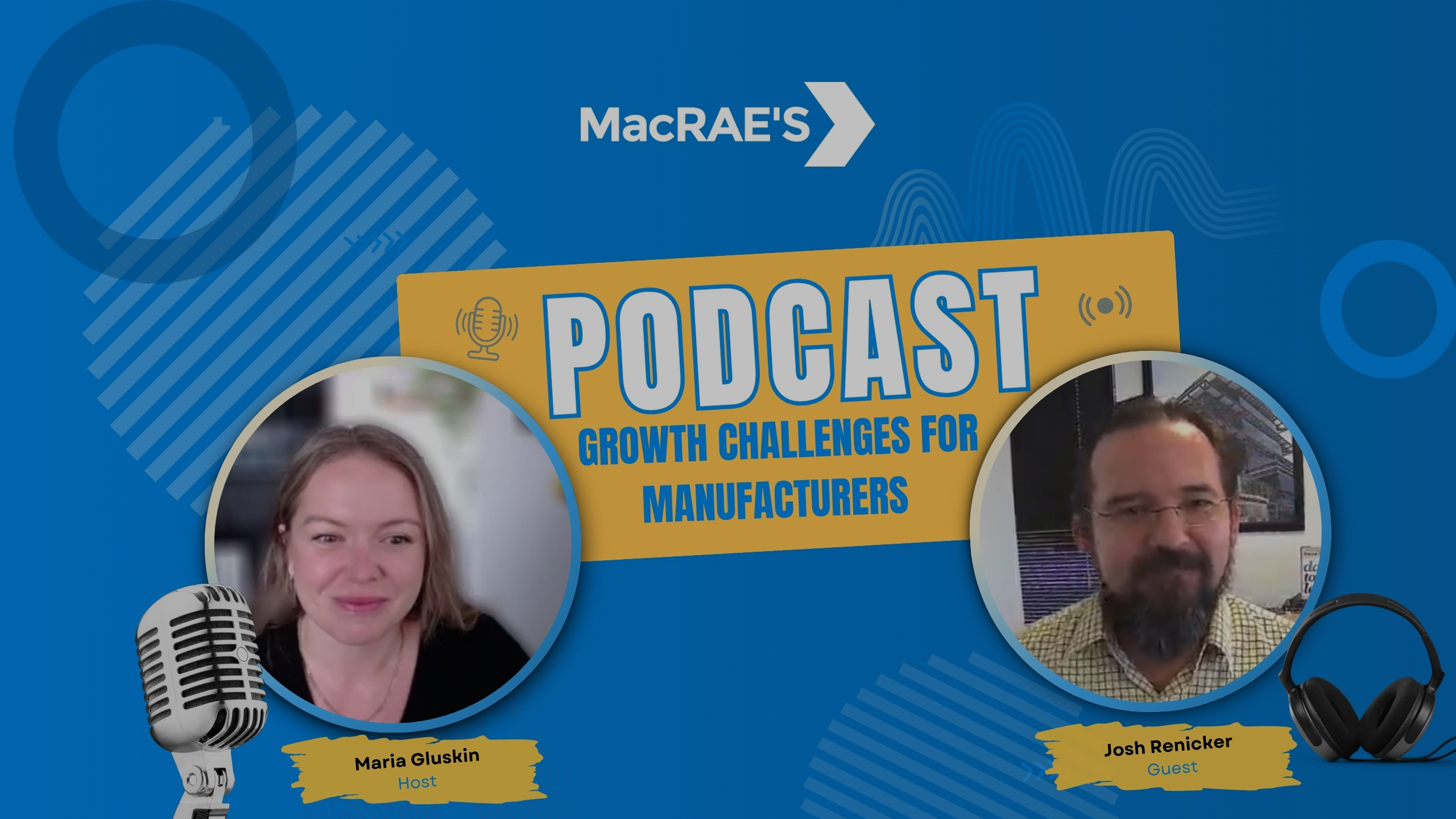
Inside with B2B and manufacturing leaders where we uncover their stories, strategies and solutions to overcoming growth challenges in their industries. I’m your host Maria. And in each episode, we will dive deep with founders, CEOs and industry experts to explore how they scale, innovate and lead in today’s competitive landscape. So let’s get started. Today we have Josh from Energy Access. Nice to meet you. How are you today?
Josh Renicker (00:28)
Nice to meet you as well, I’m great, thanks for having me.
MacRAE’S (00:31)
Also Josh, and Josh, where are you calling from?
Josh Renicker (00:33)
So I’m here at Energy Access, which is in Indianapolis, Indiana. So the company is, what, 27 years old, something like that. I joined in 2006, so I’ll be celebrating 20 years leading operations here. And we do electronics, power electronics, battery chargers, power management systems, and battery protection circuits.
We do design, development, and some small assembly. So we’re a high-mix, low-volume manufacturer here in the Midwest.
MacRAE’S (01:06)
And Josh, what drew you personally into this space?
Josh Renicker (01:11)
That’s an interesting question. What drew me personally was that the owner of Energy Access at the time in 2006 was going through some transition and he showed up at my college and showed up in my classroom looking for an operations manager. He spewed out a few things that he was looking for and it felt like he was talking to me. So applied for the role, contracted for a little bit and then he brought me on full time as an operations manager mid
2006, then I jumped into a director role and then took on the COO role in 2013.
MacRAE’S (01:43)
So it sounds like you worked in multiple departments in the company, is that correct?
Josh Renicker (01:47)
⁓ not really. mean, I’ve, I guess when I started, I was kind of employee number three. So I was doing a little bit of everything. and then kind of as we were growing a team under us, you know, just kind of learning my way through for the most part. so yeah, I mean, I guess I, I kind of dabbled in everything, but, ⁓ never really changed my title. I was always kind of leading operations, but all that stuff was kind of under other duties, right? It was just stuff that needed done.
and I was the guy that was there to do the work. So yeah, I kind of started grassroots and kind of a startup culture, know, everybody all hands on deck all the time, learning everything, and then started to bring on a team and delegate more of that work out to the team and then stepped out of more of the day-to-day stuff with the COO role and more of just kind of leading and growing people more than anything else.
MacRAE’S (02:37)
That’s amazing. when you started three people in the company, were three people in the company and how many people are in the company now?
Josh Renicker (02:43)
We’re still less than 20, ⁓ but that’s a little bit of a weird number because we do work with lot of partner contract manufacturing groups. So really there are several hundred people that support us, but here internally we’re less than 20 people. But we’re lean, mean, and ready to do some fun stuff in electronics.
MacRAE’S (03:04)
love it. Fun stuff in electronics. Why don’t you tell me a little bit more about that?
Josh Renicker (03:08)
Yeah, so ⁓ we focus on kind of the low to medium volume, ⁓ high value, critical power applications. So we do stuff in medical, military, test and measurement, fire health and safety. We do some robotic stuff, material handling, and then drones, of course, are starting to become more and more so. So we basically get involved with engineering teams that are so excited about
their work that they’re doing in their companies that Generally speaking when it comes to the power side They don’t want to pull their engineering staff away from from their own IP in their own technology So they’ll come to us because we already have the battery charging and power management pieces figured out so basically what they’ll do is they’ll come to us and and and work with our team to develop a application specific full power system, so that could be
embedded systems, could be a rack mount system, it could be a small desktop even like a dock. So depending on the application, they’ll work with us, use our technology to make sure that the battery life and the power they’re getting out of the battery is continual, right? Just to make sure that they’re not burning through battery packs. And they work with us because a lot of times we already have the ⁓ third party agency approval stuff already done.
so they can leverage a lot of that third party validation work and not have to pay for a lot of that upfront. So it gives them a quality product, something that fits their application and something that’s market ready. So it’s kind of the three boxes that we tick when we get pulled into a project.
MacRAE’S (04:47)
and frees up a lot of their resources to focus on things that they need to as opposed to that stuff. You work in such like a lot of variety, like the industries that you work with, there’s a lot of different industries that you listed. How do people even find you from such a variety of industries?
Josh Renicker (04:53)
Correct.
Yeah, the interesting thing is most of our business comes through companies that are building batteries. So because we don’t build batteries, we build power systems that support batteries. We can’t go out and sell to just anybody, right? They have to have a battery to charge. It doesn’t matter how cool our product is. If there’s no battery to charge, they don’t need our product, right? So we have relationships with probably 30 to 35 companies just in North America alone.
that build battery packs. So their focus is to build battery packs and not chargers, not power management systems. So they’ll come to us so that they can offer up their battery pack where their expertise is and our charger solution as kind of a package deal. So much of our business comes through just those strong partnerships that we have with battery assemblers. And then each one of those companies has a whole sales team that is out.
⁓ kind of focused on different market segments, right? So we almost have to speak all those languages because I mean, in any given day, we could be working with five or six different battery assemblers that are working on five or six different programs that are in five or six different industries. So we could be in a situation where we get off of a medical call and we’re immediately jumped into a robotics call. So being able to switch and change our language and understand those applications is something we’ve been able to leverage for our entire history.
MacRAE’S (06:29)
Yeah, and it sounds like such interesting work because if you have that type of diversity, right, you solve a problem in one industry, then you solve a problem in a different industry. You just constantly are growing and challenged because all those industries are basically they all have moving parts that are changing, right?
Josh Renicker (06:45)
Yeah, that’s some of the interesting part of it is what we get involved in. Like the core algorithms of battery charging haven’t really changed. Things have gotten smaller and more efficient, excuse me, but the applications have changed drastically. you know, an application where something has to go through a cleaning process in a medical application because it’s an operating room tool is very, very different.
from the requirements that we might need for a radio that’s gonna be used in a mining application, right? So I mean, the charging algorithm and what we’re doing internally is the same, it’s the same battery pack, it could be the same battery pack. But what we wrap around that, the protections, the housings, the materials that we use, the labeling, the agency markings, all those kind of things are vastly different.
just based on the application that it’s in, even though deep down the technology inside the box is the same. So we find ourselves most of the time basically saying like, we’ve got the charging figured out, we need to understand the application more than anything else, because that’s, it’s really like a UX approach to solving problems using power electronics, right? So our focus tends to be, okay, we understand the tech, we understand what you’re trying to do, but how’s the user gonna use it?
really where we can bring value. that’s that, generally speaking, that’s our focus when we’re kind of onboarding or gathering requirements. It’s more about use case, user, how the battery is gonna be used, how it could be abused, right? Because people abuse battery packs, right? People abuse chargers, right? How many phone chargers have you been through in your life? Probably more than phones, right? So it’s, yeah, of course, who doesn’t, right?
MacRAE’S (08:29)
I have a whole box.
Josh Renicker (08:32)
So that’s kind of the mindset we go in with is how could this be messed up? How could it be abused? How can we make sure that if those things happen, when they happen, that it’s still safe, right? That’s the most important thing.
MacRAE’S (08:45)
Yeah.
What is the risk to your clients and their end customers if it’s being abused?
Josh Renicker (08:52)
I mean, could be catastrophic, right? It could be a loss of life because I don’t know if you’ve seen on YouTube some EVs that catch fire and they burn very, very quickly and very, very hot. So when you’re dealing with lithium, they burn fast and hot, right? So our plan is to make sure that the charger solution and even inside the battery pack at times when we do a battery protection circuit.
is to make sure that when things go wrong, it goes wrong in a safe way and things fail safely so that the battery can be removed. I mean, there are those instances where the battery gets abused enough that no matter how much safety we put in place, we still have a failure, right? But we do, I mean, we do everything that we can from the design and development standpoint to make sure that things are built well.
things are designed appropriately for the application and the appropriate and effective safety measures are in place.
MacRAE’S (09:49)
⁓ And this is interesting because the energy and power conversion industry is undergoing really a lot of rapid changes, whether it’s from electrification to automation to renewables, right? There’s different sources that people are implementing now. What major shifts are you seeing right now that are shaping opportunities for companies like yours?
Josh Renicker (10:12)
Yeah, it’s a couple of things really, because I mean, yeah, electrification is becoming a thing and a lot of industries are looking for ways to make things battery powered, right? To not have to rely on things being tethered is what we, tethered is the line we use in the industry. Untethering the operating room is a huge push. So we’re seeing a lot of that, but really.
the kind of evolution of the EV world, though we don’t play in the EV world, it certainly impacts our industry. are factories being built, I mean, they’re fully automated, so there’s four people working in a million square feet, but there are factories being built to support this massively growing, this fast growing EV market, and it’s impacting, I mean, we saw it impact,
the auto industry here in the US in just after COVID, right? Cause all the automakers were like, hey, we can build cars, we’re short on chips. We’re short on things because the electronics industry is just booming. And now we’re at a point where really vehicles are computerized, right? So for the first time in history, the auto market is in direct competition with a consumer market.
which is for electronics. That’s never happened before, because the auto industry has always kind of been in its own bubble, where all these companies will support just the auto industry. But when you’re talking electronics, it’s the same people supporting a laptop that’s supporting Tesla or supporting Ford or supporting Chrysler. So for the first time ever, we’ve got this situation where we’ve got multiple industries chasing the same electronic parts. And obviously the auto industry is massive, right? It’s a huge industry. So that’s why we ended up in this situation.
MacRAE’S (11:28)
interesting
Josh Renicker (11:54)
I mean, it’s a perfect storm, you know, supply chain issues, shortages of parts, and then a spike in demand. So because of all that, it’s impacting things at the lower level because for us, what we’re looking for is lower volume stuff, right? So we’re looking for an OEM that’s maybe only gonna build a thousand of something. So they have to make really critical decisions on which component they’re gonna use so that their thousand pieces are available.
Right? If somebody’s, if you’ve got an order of a million something and somebody comes in and needs a thousand, which order are you going to fill first? You’re going to go after the million pieces, right? But that’s, that’s not our customers. So that’s, that’s one of the interesting things that we, what we ended up doing, how it shifted us personally is when things started to kind of go awry, we had a couple of development programs in the works and we started to see component availability become limited. So we started to actually develop
MacRAE’S (12:30)
Of the millions. Of course.
Josh Renicker (12:50)
two circuits in parallel. So it was like, this is the ideal design that we would use if we can get the parts that we would want to use. But if we, for some reason, can’t get these three critical parts, we have to completely change our architecture and go this way. So we started to develop things in parallel so that way we could respond if by the time we got to a point where we ready to go to production, okay, our supply chain issue’s over and now we can get all these parts or are we still in this situation where
we have a part or two that may be gray, right? We don’t know if we can get it or we could get it as an aftermarket part. If that’s the case, then let’s mitigate the risk. We’ll design with parts we know we can get and then use the ideal design as something we can implement later as like a phase two once supply chain issues go away. But it shifted our engineering team from kind of strictly development focus to starting to go out and understand supply chain challenges and
and kind of sourcing, right? Going out and finding what parts are out there and where and why. And so it was an interesting transition for us that allowed us to develop our engineering staff into somewhat like supply chain experts, because they had to understand where the limitations were. Because before it was like, go out and design stuff and let the procurement team figure out how to buy the stuff, right? But that transition really…
helped us grow because now there was like this mutual respect that’s like, wow, procurement’s actually difficult to go out and find parts and make it work.
MacRAE’S (14:20)
Yeah.
Has that opened the doors and opportunities for new type of clients for you guys? Because I know you mentioned earlier a lot of it is relationship if you have a few partners, but has that also opened the doors for new potential business for you guys?
Josh Renicker (14:38)
Yeah, the interesting thing it was, so through the whole COVID season, we were considered essential because we were building medical devices. So it opened up the window for some larger manufacturers to come to us and request us to build things that didn’t really fit our business model. So what that ended up doing though, was it made us kind of take a really strong look in the mirror, right? Because it was like, okay,
you know, our low volume, high mix model is what we’re really, really good at. And then we had people coming in saying, how fast can we get 50,000 of something? And we’re like, wow, that would be really awesome if we were built that way. So we had to tell some really well-known brand names no. And they were like, what do you mean no? You know, because their thought was, we’re coming to you to help bail us out.
And you our comment back to them was like, look, you made a conscious decision years ago to purchase product ready-made overseas. Your costing model was based on that and we can’t be competitive. So why would we now change our business model to bail you out such that when things got back to normal, you would just abandon us again and go back to where you can get it cheap. So.
It definitely was an opportunity for us, but it was an opportunity that we decided not to participate in.
MacRAE’S (16:06)
Yeah, because it could have been a very short term opportunity anyways, right? When things would have picked up, they might have continued going back to just being more cost driven as far as choosing their suppliers compared to actual value and relationship building.
Josh Renicker (16:20)
Exactly, and that’s not our business model, right? So I mean, if we signed up for that and then started to neglect our partners that are here because they align with us, then we’d be out of business.
MacRAE’S (16:31)
And those big companies, like how did they find you?
Josh Renicker (16:35)
Good question. A lot of them found us through battery assemblers because they were doing the same thing with their battery packs. And because we have so many relationships in the battery assembler world, a lot of the big companies would go out and find three battery assemblers and ask where to get chargers and they would all three point to us. So, you know, it was one of those situations where, I mean, we’re somewhat of an industry leader in what we do. So we have a really strong reputation with
with those battery assembling companies. yeah, I mean, all it takes is a couple of ⁓ OEMs going to the same companies that are listed and they all point back to us. yeah, I mean, a lot of that stuff again, because, you know, nobody goes and buys something because the charger is cool, right? The charger is a utility device, right? It’s something like the battery matters, the device matters, the charger just needs to work when we want it to work. So.
MacRAE’S (17:19)
Yeah.
100%.
Josh Renicker (17:28)
So, you know, they’re like, this is a problem we need to solve. Who can help us? And they’re like, well, we buy the battery here. What do they have to say? They should know. And they do, right?
MacRAE’S (17:38)
Yeah. then, okay, so those big companies obviously that did not align for you, but with the changes that you were making, are you internally looking to get into new markets and attract new clients?
Josh Renicker (17:49)
I mean, yes. I mean, we are continually adding new markets. mean, keep, every time a new show pops up around the country, I’m like, there’s charging in that. So let’s go figure it out. So yeah, I mean, I think we’re currently, gosh, what are we in? 20, maybe more markets. And again, it’s so application specific.
And what we find is it’s a lot of like tangent markets, right? So one of the markets we’re in is vet medicine. So because we do medical stuff, there’s a lot of veterinary tools out there that are also battery powered. So we support some veterinary stuff. Because we are doing some like material handling cart kind of stuff, the people that are developing autonomous pallets come and find us.
because we’re kind of in that mix between robotics and material handling. So, you know, it’s kind of the tangent thing and it kind of grows out like a spider web almost. And yeah, it’s continually evolving. It is just continually evolving. I mean, we are continually finding new market segments that really years ago we didn’t even know existed. And right away we find opportunities there because everybody’s trying to untether.
MacRAE’S (19:04)
Because their industries are changing too, right? Like they’re developing new tools and new systems that will require your services as well. You mentioned a couple of times that they find you. that like where do people find you? Is it through trade shows? Is it all in person? Do people search something online and then you land? How does it go?
Josh Renicker (19:23)
Yeah, a couple different things. we’re very people driven, right? So we’re human centric. And so the relationships that we have with the battery assembler world are personal relationships. So a lot of times what ends up happening is a conversation happens and the recommendation is not call Energy Access. The recommendation is call Josh at Energy Access, right? Cause it is a personal thing.
MacRAE’S (19:47)
you
Josh Renicker (19:50)
that not only do they know the company, but they know our people, right? And then the other way is I’m super active on LinkedIn. So we get a ton of stuff just coming through people responding to what I’m sharing on LinkedIn of kind of how our operation works or some of the new tech that we’re working on. It’s interesting, we’ve seen a shift and I don’t know if you’ve seen this.
And we’ve seen it in recruitment and we’ve also seen it in trying to find new customers. There’s far less value put on company websites these days. There’s so much more value in third party validation, like Google reviews or showing up in somebody else’s project report or things like that where third parties can go out and unrestricted can go out and
post something about your organization. So, you know, we’ve spent tons of time on our website. Like, what do we need on our website? And I’m like, team, our website is probably good enough. Really what we need is the people who use us to go out and talk about us. Because that’s where, and we find that with recruitment as well. Because I had, we’re hiring, not too long ago, we were hiring a customer success person and they didn’t even go to our website.
MacRAE’S (20:55)
Mmm.
Josh Renicker (21:05)
They’re like, we didn’t go to your website. We wanted to go see what people say about you. That’s what really matters. Because there’s so little value put on what people say about themselves these days. So it’s amazing. I don’t know if you’ve seen that as well, just kind of across the board.
MacRAE’S (21:09)
Yeah.
Yeah, well, I mean, what we find on our end being a digital based agency is that the way that people search is so different now. That is really the biggest change here. So your website, it’s still important because you want to make sure that is optimized in a way that you’re finding the people who are asking certain questions, they’re still finding you. Now,
Josh Renicker (21:29)
Yeah.
MacRAE’S (21:46)
But now it’s not just on Google or a Google reviews that goes on across your whole digital footprint. So for example, like a lot of people and I can see how somebody who works in a clinic and has a problem to solve and they start typing in on chat GPT, hey, I have this problem, how do I solve it? And if part of the solution is your services, then you want to be
the person who actually pops up on chat GPT. I think that, and other ones, there’s Genesis and Claude and a lot of other ones. And it’s just the way that people are searching is very different. So optimization of content is still extremely important because you don’t want to just rank based on your name and who you are, but it’s the problems that you’re actually solving. And I think that is
an insane opportunity right now for a lot of companies where are from what I can see are in a position where SEO where it was in 2007 where Facebook was just launched when crypto was just launched when all of these big big innovative when the internet was just launched all these big scary things that used to scare the public but now they’re just part of our everyday life and I think that companies will have to adapt really quickly because
Josh Renicker (22:57)
Yeah.
MacRAE’S (23:11)
Because machines are innovating machines now, you have to make sure that you are being searched and found based on the problems that you’re solving, not just who you are.
Josh Renicker (23:22)
Yeah.
Right. So it’s a UX based digital footprint, right? Cause it’s way more than just a website because yeah, you can have those, that content on your website, but you’ve got to have blog posts that get published. You’ve got to have a LinkedIn presence. You’ve got to have, you’ve got to have other avenues that are out there. And it is truly a ⁓ digital footprint that is user.
MacRAE’S (23:29)
Exactly.
Exactly.
Josh Renicker (23:47)
focused, right? It’s the problem we solve, not the product we make.
MacRAE’S (23:51)
Yes, and you need to have a very strong strategy that actually takes into consideration the social, the web, and the generative search engines, so the AI-based ones, and that it can scan the whole thing and your strategy is so mainstream that if somebody is trying to specifically solve the problem that you can, you are the person who’s popping up. And I think right now, based on what we’re seeing with our clients, the people who can catch up much quicker,
can really reap the benefits the way that the people who figured out SEO 20 years ago were able to do that. Because right now, just focusing on optimizing the content on your website is not enough. has to be like you said, the whole digital footprint. Yeah.
Josh Renicker (24:38)
Yep, yep, that’s what we’re saying as well.
MacRAE’S (24:40)
What are some, like you would say, the most innovative approaches you’ve recently tried to attract new customers and grow your business? And how did that turn out for you?
Josh Renicker (24:51)
⁓ so I mean, I guess we’ve always kind of leveraged people first, right? so it’s about being in person. It’s about, I mean, even during the COVID times when we couldn’t travel and do those things and we were doing everything we could to get face to face with people. Cause I feel like, you know, a pendulum is shifting here a bit, you know, with the COVID era.
made opportunities like this super easy, right? Where we can hop on two screens, we have cameras, we have all the things, and we can meet no matter where we are in the world. But the conversation we would have sitting in a coffee shop at the same table would be very different, right? So we’ve tried to maintain that kind of personal edge, but we have added some, there’s a ton of CRMs out there that you can use to do some of that outreach and.
and making sure you’re at least targeting some customers that might make sense. That industry is super, super saturated at the moment and there’s a lot of garbage and a lot of noise. So it’s difficult to kind of make yourself stand out in that. And again, that’s partly why we still focus on being face to face, right? Because that’s what makes you memorable. Because how many leaders do you know that spend half their day in this scenario?
right, where they’re on a Zoom call or they’re on whatever, you know, whatever platform it is, everybody’s in their own little box. Everybody’s the same height. Everybody smells the same. So, you know, until you get in the room with somebody and are able to truly get vulnerable and not have to schedule the time, right? Like this time with us together was scheduled, right? It’s very different than when you’re sitting in somebody’s office and you bring up something that’s sitting on their desk, right?
which that’s kind of missing in this element. mean, sure, you could see some things in the background you could pick on, but it’s very different. you know, it’s that, it is that balance of, you know, how do we go, and it’s generational as well. Let me throw the generational piece in there because each generation has a different comfort level with how they’re approached. So you do almost have to have five different approaches based on.
the five different generations that are in the workforce these days. So you kind of have to take all five of those and have a strategy in each flavor and kind of see what sticks. some of that could change. We’ve seen that change. So because of some of the programs we’re in, we get in development projects that are a medical project that may take three years. In that three year time span, we could be working with a boomer engineer, a millennial engineer, and a Gen Z engineer over the span of that time.
MacRAE’S (27:29)
Yep. Yep.
Josh Renicker (27:31)
The communication, the approach, the comfort level with people in the room, all those things change based on those dynamics of who’s on the project team. So for us being able to be, we almost take like a lean, agile approach to how to be in the room so that we understand the dynamics and understand that we may need to communicate the same thing three different ways on the same call even.
MacRAE’S (27:58)
Yeah. But, yeah.
Josh Renicker (27:59)
So it’s that flexibility
piece I think is really what we focus on. It’s not grabbing one thing and running with it.
MacRAE’S (28:06)
Yeah, because you want to seize any type of opportunity, especially in an industry where things are changing, not just the people who are doing the work, but the process and the product and the service itself is changing because of other environments. So yeah, staying adaptable is so, important. I totally agree with you. And it’s so true. Gen Zs are in the force now. There is engineers out there, 24, right? 22. They’re just fresh out of university.
Josh Renicker (28:31)
Yes.
Yep, yep.
MacRAE’S (28:33)
And they’re
in the offices. That’s right. Three generations. Yes. I’m a millennial. So I didn’t think about that. I still think we are the ones earning our stripes still, but it’s true. There’s other ones behind us who are now earning their strikes as well. Tell me, ⁓ how do you see AI automation and data analytics shaping your industry over the next five years?
Josh Renicker (28:36)
They are, they’re not comfortable being in the offices, but they are in the offices.
Yep, 100%, 100%.
So two things I would touch on here. So for the high volume making simple widget manufacturing piece, the data analytics and AI stuff is industry 4.0, lights out manufacturing, everything can be automated, one person running a full facility and just monitoring what’s going on in the machines and machines being able to take action when they see trends and doing things.
I mean, I definitely see that piece. And that’s something I find interesting in the US specifically, the idea of bring manufacturing back to the US. Like that’s not a thing. We’re not bringing manufacturing, the kind of manufacturing that left is not what we’re bringing back, right? The kind of manufacturing that’s being invented here is full automation, right? We’re not throwing people at things anymore. So the idea of like bringing manufacturing back is not really a thing.
The other piece of this is, so in my role, leading operations, the generative AI tools that are out there, you’ll chat GPT, all those guys, using those as a companion piece for everybody who is in our facility. You know, there’s definitely a fear that’s floating around that
that our jobs are going to be replaced by AI, right? That’s been thrown around a lot. But what I see is it’s a phenomenal tool to use. It’s a phenomenal thing to make you super efficient at things that would generally take you too long to do. And the folks that will leverage it, understand it, and find ways to use it to do
more better work are gonna be out front. They’re gonna be out front by like a long way. So I’m a member of the COO forum, which is a ⁓ professional development network specifically for top level operations leaders, right? And the topic of AI comes up frequently in our sessions there. And none of us are concerned that our jobs are gonna be replaced by AI.
Like not one of us are like, yeah, I’m afraid that because we still lead people, right? Like our role is still developing people. But I will say that we are all using AI as a companion piece to our jobs. we’re all, not only are we advocating for our teams to use leverage AI, but we’re pushing it. We’re driving it.
How can AI help you do this work? How can AI help you do this? How can AI help you answer this question? So, you know, it’s an embracing of this new technology. And yeah, it’s messy, and yeah, it’s unknown, and yeah, there’s things that just go weird and sideways. But there’s enough value there that if you have the blinders on, the world is gonna pass you by in the blink of an eye.
MacRAE’S (31:30)
I love it.
Okay.
Josh Renicker (31:56)
And I mean, just trying to stay up with all of the technologies that are out there. I mean, there’s new AI tools popping up every day, every hour in some cases. A lot of it is noise, right? Don’t get me wrong, a lot of it is noise. But there’s definitely some good value out there and I’m using it across the board. mean, I’m using it for some social work. I’m using it for job descriptions. I’m using it for…
performing quality objective stuff. I’m using it for reviewing reports, right? Like upload a report, review this, give me an executive summary, because I don’t have time to read this. There’s so many ways that you can leverage it, and honestly, I use it, I was talking to somebody just yesterday, I use it as a sounding board. I use it almost as an admin assistant, right? A virtual assistant.
I feel like I’m in 1965, I’m walking around with a cigarette in my hand in my office, just like spewing nonsense because I have the microphone on. And I’m like, hey, just put together those thoughts for me and put that in a report. I’m going to email this person about it. So put that email together for me.
MacRAE’S (32:56)
Except that it doesn’t feel abusive. Doesn’t feel like you’re yelling at a person.
Josh Renicker (32:59)
I know, yeah, I can swear
and jump and yell at the thing and it’s like, oh Josh, yeah, you’re right on, you’re right, that’s perfect. So it’s awesome, yeah, I mean use it, I mean have a 35 minute commute to work and back every day, right? So I I spend 15 minutes just recapping my day on my way home, it’s a way of journaling. So there’s a lot of different things you can do with it and you have to embrace it though. If you don’t embrace it, you’re gonna be left behind.
MacRAE’S (33:05)
No problem, yeah, you got it, whatever you want, yep, no problem, yeah.
Yeah, I love it.
The way that we always look at it, so we are an AI driven company because we help our clients appear all across social, like anything that is digital, basically to just strengthen your digital presence in a way that again, when people search for the problems that they’re trying to solve, not so much just the, like what is it that people try to solve and we help our clients appear high on those in all of those areas.
The way that we look at it and the way that we communicated within our team and our clients is we say that AI will take care of all the things that are taking you away from creativity. So humans are now AI machines, they’re not creative. The way that they’re built up, they’re not creative. They’re great for executing tasks. They’re great for doing some research. They’re great for doing some things together. But as far as human creativity,
that has not been replaced yet and I don’t think that’s gonna happen anytime soon because that’s something that is very hard to put into a program, that human creativity part. So that’s how we look at it and it sounds like you guys, you yourself are looking at it very similarly.
Josh Renicker (34:37)
Yeah, mean, there’s the human element, right? I mean, people have souls, right? AI does not have a soul. you know, AI doesn’t have a gut feel, you know? So it is fascinating because like, yeah, leading operations, it’s messy. It’s emotional. It’s, you’re dealing with people’s livelihoods. It’s hard, challenging, tiring work, right?
MacRAE’S (34:45)
No, no.
Josh Renicker (35:05)
None of those things I can have ChatGPT do for me. Right? Like I can use that, I can use ChatGPT to say, hey, I’m about to have a difficult conversation. Here’s the context. Help me kind of frame this in a certain way, right? Because that’s a class. It’s not going to go and have the conversation for me, right? Yeah, hey, by the way, I’m going to have you stand here and type out these answers. I’m going to go out there, right? That’s just not a thing.
MacRAE’S (35:08)
No.
But it’s not going to talk for you.
knock on the door be like hey.
Imagine? No.
Josh Renicker (35:31)
So yeah, I
completely agree with you. I love the way you frame that in that it doesn’t do the creativity piece and it’ll do all the stuff that isn’t creative for you.
MacRAE’S (35:40)
Yeah, awesome. Well, Josh, thank you so much. This is our time for today. Thank you so much for coming and joining us. I loved hearing about all this and it sounds like you’re really on the right path with some of the ideas and how you’re incorporating things and the modern world for something that has been around for such a long time. I love it. Thank you so much.
Josh Renicker (35:59)
Thank you for having me, I really appreciate it.
MacRAE’S (36:01)
Of course. Okay, I’m gonna stop it.
- 1. Quality products with proven technology
- 2. Application-specific customization tailored to unique use cases
- 3. Market-ready solutions with third-party agency approvals already completed
- How will the user actually use this device?
- What environmental conditions will it face?
- How might the battery pack or charger be abused?
- What protections, housings, and materials are needed for this specific application?
- Content creation: Social media posts and job descriptions
- Report analysis: Quick executive summaries of lengthy documents
- Communication: Drafting emails and preparing for difficult conversations
- Daily journaling: Using his 35-minute commute to recap his day via voice
- 1. Strategic partnerships can multiply your capabilities. You don’t need to do everything in-house. Build relationships that complement your core competencies.
- 2. Deep application knowledge differentiates commodity products. Understanding how customers actually use your product in real-world contexts creates value beyond the technology itself.
- 3. Being lean isn’t a limitation—it’s a competitive advantage. Small, focused teams can serve diverse markets by partnering strategically and leveraging technology effectively.
- 4. Embrace AI proactively. Use it as a tool to enhance human capabilities, not replace them. The leaders who integrate AI effectively will have a significant competitive advantage.
- 5. The human element remains irreplaceable. Leadership, creativity, intuition, and emotional intelligence are uniquely human capabilities that technology enhances but cannot replicate.
Energy Access has been innovating in power electronics for over 27 years, serving industries from medical devices to robotics with customized power management solutions. Their lean operation model and strategic partnership approach offer a blueprint for B2B manufacturing in the modern era.
More Podcasts
Standing Out in a Competitive Market: How AT Sensors is Navigating the AI Era
November 3, 2025 18:23
Watch Podcast →
From Online to Everywhere: How Obvi Scaled from D2C to 20,000 Retail Doors
November 3, 2025 16:05
Watch Podcast →
How Assett Transforms Female Founders Through Strategic Branding
November 3, 2025 14:48
Watch Podcast →