- Home
- Services
Curious How You Show Up in ChatGPT?
See where AI search recommends you, and where it recommends a competitor instead.
Driven by Values, Focused on Your Growth
MacRAE’S founder, Hugh Owen, recognized early the rise of AI and digital acceleration. His vision defines MacRAE’S as a future-ready growth partner.
Curious How You Show Up in ChatGPT?
See where AI search recommends you, and where it recommends a competitor instead.
Driven by Values, Focused on Your Growth
MacRAE’S founder, Hugh Owen, recognized early the rise of AI and digital acceleration. His vision defines MacRAE’S as a future-ready growth partner.
Curious How You Show Up in ChatGPT?
See where AI search recommends you, and where it recommends a competitor instead.
Driven by Values, Focused on Your Growth
MacRAE’S founder, Hugh Owen, recognized early the rise of AI and digital acceleration. His vision defines MacRAE’S as a future-ready growth partner.
- AI SEO
Curious How You Show Up in ChatGPT?
See where AI search recommends you, and where it recommends a competitor instead.
Driven by Values, Focused on Your Growth
MacRAE’S founder, Hugh Owen, recognized early the rise of AI and digital acceleration. His vision defines MacRAE’S as a future-ready growth partner.
Curious How You Show Up in ChatGPT?
See where AI search recommends you, and where it recommends a competitor instead.
Driven by Values, Focused on Your Growth
MacRAE’S founder, Hugh Owen, recognized early the rise of AI and digital acceleration. His vision defines MacRAE’S as a future-ready growth partner.
Curious How You Show Up in ChatGPT?
See where AI search recommends you, and where it recommends a competitor instead.
Driven by Values, Focused on Your Growth
MacRAE’S founder, Hugh Owen, recognized early the rise of AI and digital acceleration. His vision defines MacRAE’S as a future-ready growth partner.
- Company



Contact US
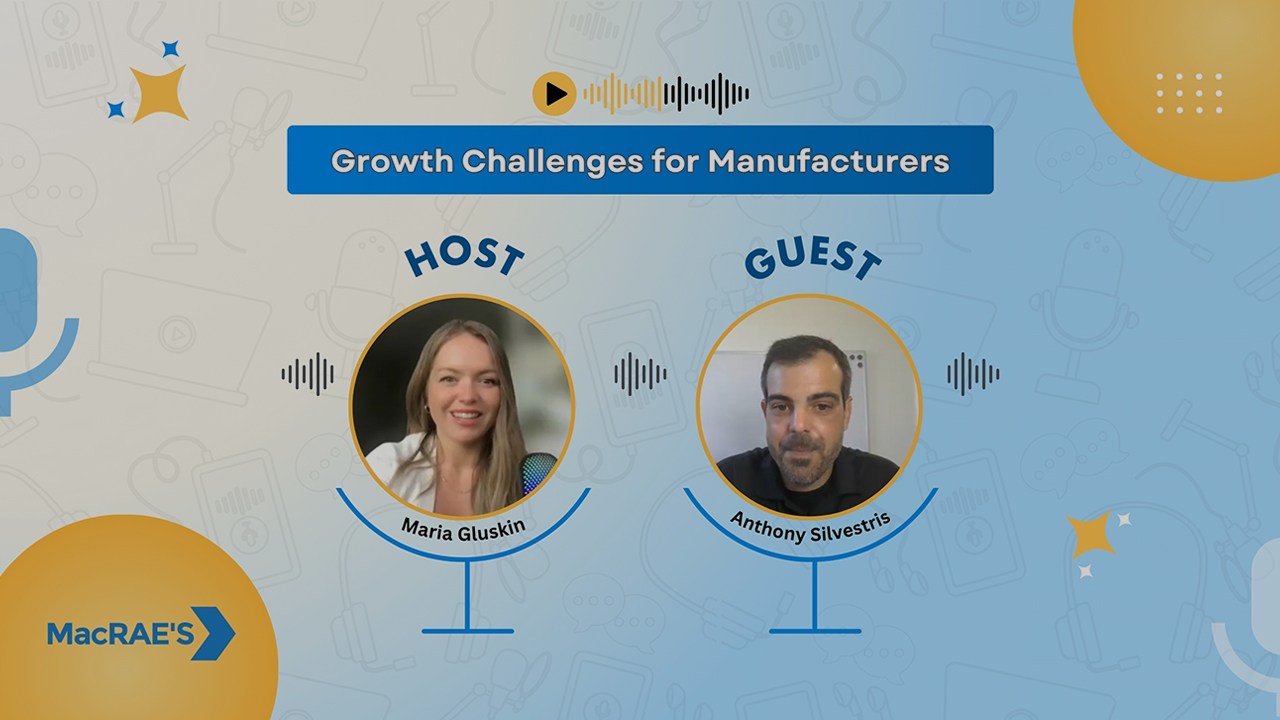

Transcript
Maria (00:05)
Hi everyone. And welcome to the MacRAE’S growth challenge podcast inside with B2B and manufacturing leaders where we uncover their stories, strategies, and solutions to upcoming growth challenges in their industries and in the market. I’m your host Maria. And in each episode, we will dive deep with founders, CEOs, and industry experts to explore how to scale.
innovate and lead in today’s competitive landscape. So let’s get started. Today we have Anthony from Luminit. Nice having you. How are you today?
Anthony (00:38)
I’m doing great. Thanks for having me, Maria.
Maria (00:40)
Yeah, of course. So Anthony, for our audience, can you please introduce yourself and your company and what is it that you guys do?
Anthony (00:48)
Sure. Yeah, so I’m Anthony Silvestris. I lead the sales team for North America and Europe at Luminit. ⁓ Luminit’s a manufacturer of optical components based out of Torrance, California, where we’re innovating different microstructures with core competency and holography and mass production using roll-to-roll and injection molding platforms.
Maria (01:17)
Yeah. So it sounds like you have such a technical product. How do you guys really stand out in a market like that?
Anthony (01:26)
Yeah, so for our technology, it’s ⁓ using holography, which is pretty complicated by nature. But the use cases are pretty practical, right? So first, having a product that works is helpful, right? So when you’re trying to create a value chain and illumination, ⁓ having different components that help you manipulate the light is essentially the goal. And we’re kind of a
key component in that supply chain.
Maria (01:59)
That’s amazing. So key component. Can you tell me a little bit about that?
Anthony (02:04)
Sure. So ⁓ with lighting, there’s quite a few things that can be done. ⁓ We kind of break it down into two different segments, either projecting light or looking directly at it. We call that direct view. And light quality is pretty crucial. And you want the light to go where it’s supposed to. So if you’re collimating your light source to project it onto a target, we offer different microstructures that essentially give that
beam distribution proper after it’s been collimated. And then for direct view applications, like a display or different ⁓ cases like automotive rear combination lamps, you would want to take all these LED diodes. ⁓ When looking directly at it, they would create hotspots. And then our film could make a uniform surface ⁓ based off of the randomization of the microstructures that we have.
Maria (03:04)
That’s really cool. ⁓ You did mention earlier about having a product that works is very important and you just went into great depth about all the details in it. So as far as the process of R &D and the engineering ⁓ and then in correlation to your growth and marketing and sales, which is your role, is there situations where the development and R &D of new products
creates bottlenecks for the sales team.
Anthony (03:36)
Yeah, so new products are always important for growth. ⁓ Now where that growth comes from, whether it’s ⁓ internal innovation or relying on your customers for innovation, where those needs come from, kind of dictate what the path is going to be. Now, is this something that you’re organically ⁓ focused on based off of your core competency and
⁓ How challenging can that be when you try to roll out this new product? Now with a technical product at the end, it’s going to be put into a device and it needs to add value to the user experience. So there’s going to be some key factors on what you’re trying to innovate that can be manufactured based off of the platforms that you have available or the key technologies that you have in your core competency.
Maria (04:31)
Over your time working in the industry, which is almost 20 years, what are some of the biggest shifts that you’ve seen ⁓ with ⁓ technology and core competencies?
Anthony (04:45)
Yeah, so at Luminit we’re becoming a key supplier in mobility applications. So for automotive, for example. ⁓ In automotive, the growth can be substantial if you have a new design win that goes into a new vehicle. So if you’re trying to innovate something, ⁓ how can you sip this in to get the ball rolling?
and then ramp up to production that can allow you to essentially not sacrifice the quality that comes out of the manufacturing plant.
Maria (05:24)
Yeah. Is this been your kind of avenue now with more of the automotive because there is so much potential to growth there because new cars coming out all the time or?
Anthony (05:34)
Yeah, so ⁓ well, it depends on the footprint that you have in the industry and where the industry is going. So I would say a large portion of our original growth was in general illumination, which is recessed down lights, ⁓ suspended linear fixtures, things like this. ⁓ But a lot of automotive vehicles have the same type of fixtures just used in a different application space.
So back in 2012, we got designed into the first Ford Mustang, well, for us anyways. And ⁓ we were kind of a Band-Aid solution at that point. They tried to introduce LEDs, and ⁓ you could see all the diodes, which was not appealing. So the Band-Aid, throw a diffuser on there. We manufacture that. We took a lot of risk as far as ⁓ ramping up to those quantities with a lot of the…
⁓ quality requirements that automotive has and all the automotive standards. So from there to build a business around it and support that industry, there’s quite a few things that we had to overcome, right? You have quality assurance that needs to be certified. You have ⁓ different material systems that need to be authorized. Like A-MECA testing is a good example of that. There’s a three-year field test and there’s no way around it.
Now, different OEMs can essentially dictate the importance of each material so they don’t treat seat belts the same as ⁓ an ambient light fixture or a reading light. ⁓ making sure that you’re slowly progressing towards the solution ⁓ essentially can enable the growth. And then as you are in, you can then
expand the footprint with multiple vehicles that have the same issues. And for OEMs and rear combination lamps, as an example, a lot of them want a specific signature or style that makes them unique from their competitors. And homogenization is a big part of that. So if you’re trying to control the light where it’s supposed to go, if a tail light’s not bright enough, then people crash into each other. at the same time, yeah, you don’t want that.
but at the same time you want it to look nice and uniform. A good example of that would be the Dodge Durango tailgate. So in that case, if you look on the road, our diffuser over the LEDs would make it look like almost a neon light, which is smooth and appealing.
Maria (08:13)
It’s almost like you guys had to reverse engineer the whole process. It’s like you had an opportunity and then you had to kind of basically reverse engineer the whole system.
Anthony (08:23)
Well, it’s important to listen to your customers and what their asks and wants are, right? And then beyond that, having the product that are similar in different applications can allow you to introduce that product into new applications. So the light fixture of a rear combination lamp isn’t too different as far as how you engineer a recessed downlight. So we’ve been manufacturing millions of disks
that go in ⁓ Home Depot, for example, for these recessed down lights that have so many different beam distributions with the same fixture, which is very similar to like a rear combination lamp. In lighting, you typically have an LED to create the light, and then you have an optical stack to bring that light, focus it in, and then you can add the different optics to create the effect that you need.
So lighting as a whole, once LEDs were introduced, kind of allowed for innovation and new technologies that can grow beyond the incandescent lamps of the past.
Maria (09:35)
I what’s so interesting that when you talked about this process, it sounded like the whole team was really on board for quickly finding solutions and adapting and making small changes towards the needs of the customers and listening to them. Like in your experience, ⁓ have you seen companies similar to yours, maybe competitors, that did not have that type of growth mindset and did it adapt quickly enough? Have you seen that around?
Anthony (10:03)
Yeah, so ⁓ being a small company, we’re under 100 people. ⁓ You typically have to wear multiple hats, right? And I’ve seen that throughout Luminate and I’ve had to do it as well, right? And to do that and be flexible, you have to take ownership of what you’re doing and innovate rapidly. Because timing’s the most crucial. If you lose on the window, there is no opportunity, right? So if you’re ⁓ comparing against ⁓
different companies that are kind of fixed in their single platform, it can be limiting because some of those existing customers aren’t going to translate in the future, right? Some companies survive, some don’t, right? So if you’re going to keep yourself a little diversified, you can give yourselves opportunity to find products that fit within your capacity and capabilities so you can address those for the market.
Maria (11:03)
Yeah, and it worked great for you guys. I’m actually curious if there was a time where you guys were investing into a growth opportunity and it didn’t quite work out for you and you had to drop it really quick. Can you tell me maybe a story about a situation like that?
Anthony (11:20)
Yeah, I had to deal with that in both the engineering department and in sales. ⁓ We have a capability which is essentially this microstructure that controls light. ⁓ We had a application for ⁓ screens that are used in conferences or movie theaters that could be 2D and 3D at the same time. So what that was is essentially our diffuser.
that was metalized on the surface, and we put a lot of resources into this, where I had to do trials and make sure that the microstructure was uniform enough when metalized that you have the correct cosmetics. Now, unfortunately, in that application, it required a very large size. So currently, we’re manufacturing 24 inches wide, kind of as a standard.
And we’ve increased that over time. ⁓ But then, know, televisions and monitors became extremely large, right? So we were competing against a technology that just matured and almost made this metalized version obsolete.
Maria (12:37)
Gosh, how did like, well, you guys obviously have done well because you pivoted really quickly. ⁓ But if you want to, if we take a look at your internal process, right, like for, you know, manufacturing and sales, specifically sales and marketing, ⁓ what do you feel is the biggest bottleneck for your growth? Is it like, what is it?
Anthony (13:01)
yeah, so I think there could be quite a few and it depends on where you are in the process, right? So for
I would say innovating new technologies, it depends if you’re in the engineering stage, are you trying to introduce it into production or is this already in production and something scaled up quickly? We had a scenario ⁓ a few years ago where ⁓ in the automotive industry there’s the OEM that would be like the Ford, Stellantis and ⁓ GM for example. ⁓
They use tier ones. These tier ones essentially build the fixture and then supply it to the OEM. And then we’re a tier two or three depending on where we are in the chain. In this case, we were tier three. We manufacture rolls and then those get shipped to a converter. Converters will cut it down and make it to the drawings for the tier one. ⁓ And we had a situation where
We got a new design win and we didn’t know it. So forecasting was not done properly. Now that was maybe on myself where I could have been following up with this converter more frequently and known that we have a new design win. But in this case, it was kind of a supply chain issue. We didn’t forecast properly, so we didn’t have the appropriate ⁓ inventory for raw materials. And then we had to rely on our suppliers, which have
typically long lead times, right? So having, you know, poor forecasting on my end, and then a situation where you don’t want to put the customer line down. So you have pressure from the tier ones and hopefully not the OEMs, right? If you put a vehicle line down, that could be catastrophic and we don’t want that to happen, right? So ⁓ yeah, there are a few different areas and rather than
dealing with it like a fire, trying to put a firefight out, ⁓ you can essentially implement different procedures in place that can help you ⁓ make things more reliable. So in the automotive industry, they do require different PPAP levels to prove out the technology and make sure it’s repeatable. That’s the most crucial part. So if there’s cosmetic or any defects that could trickle down,
⁓ to where you don’t want to have improvement needed while you’re in the middle of manufacturing.
Maria (15:43)
⁓ Just a question for you. How do you find new growth opportunities?
Anthony (15:52)
Yeah, so there’s organic growth and then there’s different trade shows and things of that nature where you find application. You gotta find where the key decision makers are going to be. ⁓ Where do they listen? What platforms are those on? So ⁓ I would say starting with organic growth, you have to listen to your customers. They’re going to be working and innovating on taking their product to the next level. You want to be a part of that process. You want to be engaged and help innovate.
from the capabilities that you have. And then you have to ⁓ present yourself and market appropriately. And different trade shows can have these platforms where you can meet with many customers at the same time. So a good example of that could be ⁓ SID or DVN. These are different automotive trade shows that we exhibit at frequently. And we’ll showcase, demo the technology so they can get an idea.
that’ll get them brainstorming on what they would like to do with this and then take it to the next step from there.
Maria (16:58)
Speaking of demonstrating your product, I’m so curious to know how has AI and today’s technology have improved or helped you showcase your product in new ways, whether it’s AR or interactive demos. Can you tell me a little bit about that?
Anthony (17:16)
Sure, yeah, so AI is very exciting for us. It’s definitely gonna be a new movement that will probably change the world. ⁓ In our case, we wanna be able to enable AI in different means through display. So one of the advantages we have from our legacy products of holographic recording is the ability to make a true hologram. So this is now a transparent
holographic optical element that allows you to see through the material. So it’s transparent, but when illuminated and played back to the user, you can see a virtual image. Now, if you tried to implement this 20 years ago, ⁓ that wouldn’t be very helpful. You would have an augmented image that couldn’t do much. So how can it be useful for the user experience?
Now that AI is really elevating and innovating quickly, now you can power these displays and now give useful information to the people who want to experience ⁓ more from the world.
Maria (18:28)
Yeah, I feel for especially in your industry that type of technology. I can only imagine these trade shows and instead of having those banners and whatever, you just have the holograms of the products like popping up and you can look at it from all different angles, right? Like they used to in the movies 20 years ago, but now it’s
Anthony (18:45)
So
Star Wars is a little different. ⁓ So the holographic optical element and switchable Bragg gradings that we’re making ⁓ are essentially just additional components that take the transparent displays to the next level. So head-up displays have been on the road for years, but they’re pretty small and have a large projector under dash.
In our case, we can showcase a ⁓ windshield that has the hologram that has optical power inside with a tiny projector that allows you to now have a ginormous field of view. So you can see a large augmented image essentially with a large eye box. So where you can see it from that allows people who visit our booth to see the technology with
maybe off the shelf projectors that allow them to envision what is their vehicle capability is gonna be.
Maria (19:49)
Amazing. I just remember also how, you know, it’s such a natural progression for so many things in technology, like computers used to take up whole rooms and phones used to be bricks. And, ⁓ and now it’s like, you know, the next, the next stuff is like these holograms, you’re going to be able to zoom in and zoom out and flip them around outside their heads. It’s honestly so exciting.
Anthony (20:12)
Yeah, so another part of that AI we think is going to be autonomous driving, right? So I want to say Volkswagen came out with an A4 back in 2013 maybe that had that vehicle that could drive itself, right? Now having that single vehicle drive itself is great, but how do you make this whole ecosystem smart enough for them to drive themselves? So now if you create an ecosystem where all these cars are communicating,
AI can essentially take that and allow these vehicles to actually be hands-free. Now, when you are hands-free, one, you want to see what the vehicle’s doing. So what information are you going to display? Yeah, you want to know that the car sees that person that’s crossing the road. Yeah. And then you have the infotainment center. So having a transparent display for the passenger who can watch a movie.
that I can’t see as the driver is also crucial, right? So making almost movie theater experiences in the vehicle could only be enabled through AI and different technology innovations that are going towards automotive.
Maria (21:28)
Crazy. I’m actually curious to know in your specific department, sales, I’m not sure how it works for you guys in your company, sales and marketing together.
Anthony (21:37)
Mostly, yeah. So we have sales and marketing. ⁓ We have new sales rules, right? So we have a few different key members in different territories and then marketing works closely with sales, but we’re also ⁓ trying to grow different things in that space independently of sales.
Maria (22:00)
I’m actually curious to hear a little bit more about that. Have you guys used any type of AI for those departments or currently trying some things? What are you guys doing?
Anthony (22:11)
Yeah, so we’ve used multiple AI platforms. ⁓ Actually, internally at Luminant, started having ⁓ AI sessions record what we’re talking about. Having action items that are followed and cleared has been helpful. You almost have employees that are ⁓ robotically taking notes for you. Now, beyond that, on the marketing side, ⁓ the different
ideas that come up need to be organized and having AI help kind of put everything into a clear, comprehensive, ⁓ digestible approach is also helpful too. So with new information, we’re able to sip accordingly. We’ve done different promotions on LinkedIn, for example, ⁓ where they’ve actually provided different schemes that help us address a ⁓
a more digestible ⁓ platform.
Maria (23:15)
Yeah, I feel like if somebody is new to your company and maybe don’t have that in-depth experience, ⁓ like the onboarding process for a salesperson to be able to get information that is digestible and then deliver it in a clear matter, it must be so helpful.
Anthony (23:31)
Yeah, so the sales growth that we’ve had with our technology is you first have to understand the technology and then you need to put a system together that helps you work through the quotation stages and everything to mature and then you grow appropriately. So we typically have a sales engineer, so there’ll be technical based and then an account manager. If you’re a sales engineer working on new opportunities, you’ll be able to.
capture some design wins and then manage that account so you mature them and then you can essentially manage a territory.
Maria (24:12)
Yeah, for sure. Question for you. I know that you guys do ⁓ the conventional type of lead generation. So if it’s going to conferences, growing your current accounts, it sounds that there is a lot of emphasis on that, basically account management and then trade shows. But what other forms of lead generation do you guys use in your company?
Anthony (24:35)
Yeah, so we do email blasts to existing customers. We want to keep them informed. And a lot of the times they’re working on something that could use this. So without me having to organize calls with every single customer at once, we can blast our customers where they’ll get some information. And ⁓ over the last 18 years that I’ve been there, we’ve had plenty of contacts to be able to rejuvenate that.
And then LinkedIn’s been a very helpful platform as well. People are now even communicating, asking in the messages through ⁓ LinkedIn to request samples and ask questions about our technology.
Maria (25:19)
It sounds like you guys are really in a good position of a lot of inbound leads, which is so tough for a company, especially industrial company, to get so much inbound inquiries. Do you do any type of outbound at all?
Anthony (25:36)
Yeah, cold calling stuff, right? Now, when you have a technology, you have to find a decision maker who can digest and understand what you’re talking about. And a lot of the times with the technology, you want to show it rather than just say it, right? So if we’re trying to reach out, a lot of that activity would be done at trade shows where you are face to face. So if I don’t know this individual, we can give a quick introduction of who we are.
with some examples that are similar to their applications. With a sample package, a laser pointer with the diffuser shows exactly what it does ⁓ that allows them to understand who you are that could then warm that lead into a more organic opportunity.
Maria (26:27)
I thought about ways to try and demonstrate that digitally.
Anthony (26:33)
Yeah, so we’ve made YouTube videos in the past. ⁓ I look very different in those. But in that it was very helpful, even with those inbound leads, to send a link to the video that explains what it is ⁓ without needing to hear me explain it from scratch. can essentially watch those videos. ⁓ This would be a great example of me having a link and send it to.
a customer so they could maybe understand who Luminate it is. So typically you have selling above the line and below, you have management, and then you have the engineers who are gonna design it in. Those are two very different conversations. If you’re gonna sell to the engineers, it’s gonna be specification driven. If you’re gonna sell the management, they need to feel that your brand and your company is ⁓ legitimized.
Maria (27:30)
Who is usually the decision maker for your clients?
Anthony (27:33)
Yeah, so it depends on what type of product it is, but that could be the head of engineering, for example. And it depends on where you are in the value chain of what that component is. So if it’s a Band-Aid, like I mentioned earlier, where you’re just trying to homogenize, usually their management tasks those ⁓ engineers to find a solution.
It depends on where you are in that budget. So if you’re requesting pricing slightly above budget, then it has to go up the chain to get approval. ⁓ But yeah, it could be the engineers or the opposite of sales, which is procurement. So if I’m dealing with procurement and it’s price first, hopefully they understand the technology well enough to understand where the value is on what we’re charging.
Maria (28:31)
⁓ Would you say then, is then ⁓ the biggest, like I would say challenge, I would say with specifically to sales, like where would you want to see it in, let’s say six months, 12 months with efforts ⁓ improving sales cycles, speeding it up, getting more leads? Like what would you like to see happen compared to what’s happening right now?
Anthony (28:54)
Yeah, so right now is actually a pretty critical point for us because we’re trying to bring this holographic optical element to market, right? Now for this, need the ecosystems very different. ⁓ Before we were sampling something that’s an already product. Now we’re developing something that’s going to be geometry driven by a vehicle. Now you can’t ask an OEM to design their vehicle faster.
Design cycles are what they are. But if this technology isn’t implemented correctly, it can’t be used. So before, when we’re selling diffusers into a head-up display that’s on the road now, it’s an interaction one-on-one with a tier one. Now we have an ecosystem because you have a projector and now an optical film that’s gonna go in the windshield.
So now we’re working with tier ones on the windshield and tier ones on the projector, trying to manage the ecosystem while we’re maturing and developing this that can be used in production. So some of the challenges in introducing this through production is gonna be first with the scientists who make these ⁓ holographic recordings, and then it’s gonna be engineers on how to implement this through the process so it can go into production.
and then it’s gonna be introduced to production through manufacturing. So depending on where you are and how you can make that smooth could be dependent on how early they’re involved in the process, right? So if someone’s gonna be manufacturing this, they should understand what it took for that scientist to record it. And then from there, they can take ownership of that process on themselves because they…
were in early and they can bring it through. But this is gonna be the most crucial, because now the added value that we’re adding to the vehicle is much, much higher than the components that we’re currently selling. So that growth platform is gonna be exponential.
Maria (31:05)
⁓ Yeah. I know you mentioned earlier about using Email Blast and LinkedIn and some old YouTube videos. ⁓ How are you guys using those type of things to demonstrate the process that you’re in? Because I think your customers would be so interested in all of those things and where you are with them. There’s so many cool ways of demonstrating those things, even using the current AI availability.
Anthony (31:34)
Yeah, so we just got finished revamping the website. So our marketing team did a great job of ⁓ making that a lot more modern, which is extremely exciting. One of the things that we’re going to be doing is we’re exhibiting at trade shows. One of the initiatives that we want to do is now bring the marketing team with us and create content before and after the show and even during.
So if you can demonstrate in video clips rather than the long format that I did for the original ones, now we want multiple videos with key captions and good looking setups to have demonstrators that are communicated throughout that process. So we’ll have the whole team there, which is helpful. And then we can essentially use the setups that we already have exhibiting and demonstrate that.
through all of these platforms.
Maria (32:34)
awesome. And do you guys have any systems for automation and like keeping track of all of those conversations ⁓ or engaging them, keeping engaged or is it still very manual? Like grab your information, put it into the email, kind of like send it or do you have more automated systems now?
Anthony (32:50)
Well, we have the automated systems now with the meetings, right? ⁓ One of the challenges in a manufacturing environment is going to be multiple departments that have to work together, right? So meetings and schedules internally just to organize everything and make sure that everything’s being taken care of properly can be pretty large audiences, which now with AI, we’re able to capture all of this information, which has been extremely useful.
that gets rid of the he said, she said, this gets rid of, yeah, trailing off and then also creates action items for you. So when you go to the next reoccurring meeting, you can address these before ⁓ having the next conversation rather than starting from scratch.
Maria (33:41)
have to say, you look so happy when you talk about that. feel like you guys had a lot of meetings when it was like, I said this, I didn’t say this, and you said that, but there was no timeline.
Anthony (33:53)
Yeah, no, more importantly for for myself is keeping up with the progress of it, right? So now it’s all documented. And ⁓ if things were taking a little bit longer, you can have that traced and understand and then ask the appropriate questions on why it may not be progressing as as you hoped. Rather than starting a new meeting.
Maria (34:16)
Yeah.
Anthony (34:19)
from scratch where you could be talking about the same thing you had last meeting.
Maria (34:25)
Yeah, that makes sense. ⁓ As we wrap up here today, you’ve shared so many great insights. What would you say, like, if you had to leave one piece of advice to our listeners, who are also in manufacturing and industrial and are interested in growth opportunities, what would you say is the number one piece of advice you can leave to them as an industry leader yourself?
Anthony (34:48)
Sure, yeah, so one of the best advice I got while I was young and starting as an intern is be who you would like to become. A lot of people in operations or engineering, ⁓ they expect more from doing the same, right? So one of the encouraging things that I’ve been able to experience at Luminent is having growth opportunities.
through these different stages where you can prove that you are who you wanna be. ⁓ having that be ⁓ growth opportunities that are provided through different efforts that you’ve completed. So I would say ⁓ don’t rinse and repeat, try to grow through proving that you can do it.
Maria (35:39)
Yeah, I love it. Thank you so much, Anthony. It’s been such a pleasure. I really enjoyed this conversation.
Anthony (35:44)
Yeah, thanks, Maria. This has been wonderful.
Maria (35:47)
Awesome, thank you. Okay, perfect. So the guys will cut out the rest, so that’s perfect. Feeling good?
Anthony (35:54)
Yeah, that was a lot more relaxing as we got through. As I expected, it’s once the puck drops.
Maria (36:01)
Yeah, exactly. Okay, awesome. Well, thank you so much for your time today. I really appreciate it. So after the call today, ⁓ I’m going to send this recording to our team. They’re going to cut up basically the marketing materials, and then we’re going to send it your way so you can use it. But yeah, I really appreciate your time. Some of the things that you mentioned were really, really interesting. ⁓
I would love the opportunity to actually look into your website, especially now that you’ve launched a new one. Have you guys looked into your traffic that you’re getting as far as actually people coming in and how it is compared to your competitors?
Anthony (36:38)
Well, it’s hard to compare against your competitors. The number one indicator is going to be where do you land on keywords on Google, right? So if I put diffuser into Google, hopefully Luminate comes up first, right? So that’s first and foremost.
Maria (36:55)
What’s
that? Sorry to interrupt you. Do you guys know those like where you guys land and all those things?
Anthony (37:00)
Yeah, so we get key metrics where our marketing team’s following that. And they’ll go through how many clicks you get and how long they’re on each page and then how that conversion rate turns into either a sample request or a request for quote or at least engagement in general. So we track that over time and then look at those key indicators to make sure that we’re going in the right direction.
Because sometimes we’ll blast too often and you can track unsubscribes, can track ⁓ click rates, that kind of trend pullback. Sometimes it’s seasonal, sometimes it’s just too high of activity.
Maria (37:46)
Have you guys started doing SEO for the AI-based search engines yet?
Anthony (37:53)
I’m not sure. That’s a good question. I could ask your team though.
Maria (37:57)
Yeah, for sure. I would love to know a little bit more about that. That’s actually what we do really well. We’re helping companies like yourself rank on ⁓ search engines that are AI based. So like chat GPT ⁓ and those types of platforms. So it would be interesting to know if you guys actually have started doing any of that stuff yet. Awesome. All right, Anthony, thank you so much for your time. Yeah, I will be sending.
Anthony (38:16)
Okay.
When should I expect that? Is that like a one week thing, two week thing?
Maria (38:28)
Yeah, it’ll take just a few days and then we’ll send it. Okay. Okay Have a good one. Bye. Bye
Anthony (38:32)
Awesome. Thank you so much.
The manufacturing industry is evolving rapidly, and few companies exemplify this transformation better than Luminit, a California-based innovator in optical components. In a recent episode of the MacRAE’S Growth Challenge Podcast, host Maria Gluskin sat down with Anthony Silvestris, who leads the sales team for North America and Europe at Luminit, to discuss his journey from engineering intern to sales leader and how the company is positioning itself at the intersection of advanced optics, automotive innovation, and augmented reality.
Anthony’s career path is anything but conventional. While studying broadcasting in school, he interned at Luminit and found himself writing work instructions as a summer project. That seemingly simple task evolved into something much more significant during a technology transfer, where his documentation became the foundation for the company’s know-how books.
“I was focused on broadcasting while I was interning, and the two don’t cross together, but it was useful for sales,” Anthony explained. “Finding the right fit with the personality is pretty crucial.”
Since joining Luminit full-time in 2007, Anthony has witnessed the company’s evolution firsthand, transitioning from the engineering department to sales around 2009-2010. Today, Luminit manufactures products that are actually used in the broadcasting industry for entertainment lighting—bringing his career full circle in an unexpected way.
At its core, Luminit specializes in manufacturing optical components using holography and mass production techniques like roll-to-roll and injection molding. But what does that actually mean for their customers?
Luminit’s technology uses holography to manipulate light, with practical applications across two main categories: projecting light and direct view applications. For projection applications, their microstructures help collimated light achieve the proper beam distribution. For direct view applications—like displays or automotive rear combination lamps—their film creates a uniform surface by randomizing microstructures, eliminating the hotspots that would otherwise be visible when looking directly at LED diodes.
“Light quality is pretty crucial, and you want the light to go where it’s supposed to,” Anthony noted.
Luminit’s entry into the automotive market illustrates how manufacturers can successfully pivot to new industries by adapting existing capabilities. The company’s original growth came from general illumination products like recessed downlights and suspended linear fixtures. However, in 2012, Luminit was designed into the first Ford Mustang as what Anthony described as a “Band-Aid solution” when Ford tried to introduce LEDs but found that all the diodes were visible, which wasn’t appealing.
That initial opportunity required Luminit to take significant risks. The company had to ramp up to automotive quantities while meeting stringent quality requirements and automotive standards. This included getting quality assurance certified and navigating material authorization processes like AMECA testing, which involves a three-year field test with no shortcuts.
“From there to build a business around it and support that industry, there’s quite a few things that we had to overcome,” Anthony reflected. But the investment paid off. Today, Luminit’s diffusers can be seen in vehicles like the Dodge Durango tailgate, where they create what Anthony describes as an almost “neon light” effect—smooth, uniform, and appealing.
With fewer than 100 employees, Luminit operates with the agility that larger competitors often lack. This size requires team members to wear multiple hats, but it also enables rapid innovation and decision-making.
“Timing’s the most crucial,” Anthony emphasized. “If you lose on the window, there is no opportunity. If you’re comparing against different companies that are kind of fixed in their single platform, it can be limiting because some of those existing customers aren’t going to translate in the future.”
This flexibility hasn’t always led to success, however. Anthony shared a candid example of a failed investment in screens for conferences and movie theaters that could display both 2D and 3D content simultaneously. Despite significant resources invested in developing metalized diffusers with uniform microstructures, the technology was overtaken as televisions and monitors became extremely large, making their solution nearly obsolete.
Even successful companies face operational hurdles. Anthony recounted a particularly stressful situation involving poor forecasting that nearly disrupted a major automotive customer’s production line.
Luminit received a new design win without knowing it due to communication gaps with a converter in their supply chain. Without proper forecasting, they lacked adequate raw material inventory and had to rely on suppliers with long lead times. The pressure was immense—putting a vehicle production line down could be catastrophic for both the customer and Luminit’s reputation.
“Rather than dealing with it like a fire, trying to put a firefight out, you can essentially implement different procedures in place that can help you make things more reliable,” Anthony explained. The experience led to stronger implementation of automotive industry PPAP (Production Part Approval Process) levels to ensure repeatability and prevent defects during manufacturing.
Perhaps the most exciting development at Luminit is their work on transparent holographic optical elements—technology that could fundamentally change how we interact with augmented reality.
Luminit is developing transparent holographic optical elements that allow users to see through the material, but when illuminated and played back, a virtual image appears. While this technology has existed for decades, it’s only now becoming truly useful thanks to advances in AI.
“If you tried to implement this 20 years ago, that wouldn’t be very helpful. You would have an augmented image that couldn’t do much,” Anthony pointed out. “Now that AI is really elevating and innovating quickly, now you can power these displays and give useful information to the people who want to experience more from the world.”
For automotive applications, this technology is particularly compelling. While head-up displays have been on the road for years, they’re typically small with large projectors under the dashboard. Luminit can showcase a windshield with a hologram that has optical power inside and a tiny projector, allowing for a much larger field of view and eye box.
The implications extend beyond driver information displays. As autonomous driving becomes more prevalent, passengers will want entertainment options. Transparent displays could enable movie theater experiences in vehicles, with content visible to passengers but not distracting to the driver—all enabled by the convergence of AI and advanced optical technology.
Beyond their products, Luminit is also embracing AI for internal processes. The company has implemented AI tools to record meetings, automatically generate action items, and create comprehensive notes. “You almost have employees that are robotically taking notes for you,” Anthony described.
For marketing efforts, AI helps organize ideas and create clear, comprehensive, digestible content, including assistance with LinkedIn promotions. This has proven especially valuable for onboarding new salespeople who need to quickly understand and communicate complex technical products.
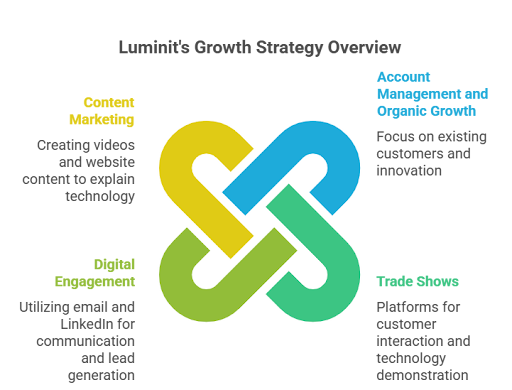
Luminit’s growth strategy combines several complementary approaches:
Account Management and Organic Growth: The company prioritizes listening to existing customers who are innovating and looking to take their products to the next level. “You want to be a part of that process. You want to be engaged and help innovate from the capabilities that you have,” Anthony emphasized.
Trade Shows: Events like SID (Society for Information Display) and DVN provide platforms to meet with multiple customers simultaneously and demonstrate technology in person—crucial for a product that’s better shown than described.
Digital Engagement: The company uses email campaigns to keep existing contacts informed, leveraging 18 years of relationship-building. LinkedIn has become an increasingly valuable platform, with customers now reaching out directly through messages to request samples and ask technical questions.
Content Marketing: Luminit has created YouTube videos to explain their technology, which Anthony can share with inbound leads “without needing to hear me explain it from scratch.” The company recently revamped their website and plans to create more short-form video content at trade shows, demonstrating products in multiple clips with captions rather than longer formats.
Selling optical components into automotive applications involves navigating complex ecosystems. In the automotive supply chain, OEMs like Ford or Stellantis use tier one suppliers who build fixtures, while Luminit operates as a tier two or three supplier, manufacturing rolls that get shipped to converters who cut them to specifications for tier ones.
For their new holographic optical elements, the ecosystem becomes even more complex. Luminit now works with tier one suppliers for both windshields and projectors, managing the ecosystem while maturing and developing technology for production use. This requires coordination between scientists who create holographic recordings, engineers who implement the process for production, and manufacturing teams who execute it.
“You can’t ask an OEM to design their vehicle faster. Design cycles are what they are,” Anthony acknowledged. “But if this technology isn’t implemented correctly, it can’t be used.”
The added value of these holographic displays to vehicles is substantially higher than Luminit’s current component offerings, making the growth platform potentially exponential—but only if they successfully navigate the development and integration challenges.
When asked what advice he’d give to other manufacturing and industrial leaders interested in growth, Anthony returned to wisdom he received early in his career: “Be who you would like to become.”
“A lot of people in operations or engineering, they expect more from doing the same,” he explained. “One of the encouraging things that I’ve been able to experience at Luminit is having growth opportunities through these different stages where you can prove that you are who you want to be. Don’t rinse and repeat—try to grow through proving that you can do it.”
Luminit’s story offers several valuable lessons for B2B manufacturers:
- Leverage existing capabilities in new markets: Luminit’s expertise in diffusers for downlights translated effectively to automotive applications, demonstrating how core competencies can open unexpected opportunities.
- Be willing to take calculated risks: Entering the automotive market required significant investment in quality systems, material testing, and capacity—but positioned the company for substantial growth.
- Stay agile and listen to customers: In a small manufacturing environment, the ability to quickly pivot and respond to customer needs can be a competitive advantage over larger, more rigid competitors.
- Invest in emerging technologies early: Luminit’s development of holographic optical elements positions them at the forefront of AR technology, even though widespread adoption may still be years away.
- Embrace AI for both products and operations: From enabling next-generation displays to streamlining internal meetings, AI creates value across the business.
- Show, don’t just tell: For complex technical products, face-to-face demonstrations at trade shows and video content remain crucial for helping customers understand the value proposition.
As Luminit continues to push the boundaries of what’s possible with optical technology, their journey from humble beginnings to the cutting edge of augmented reality serves as an inspiring example of how manufacturing companies can evolve, adapt, and thrive in an increasingly technological world.
To learn more about growth strategies for B2B and manufacturing companies, subscribe to the MacRAE’S Growth Challenge Podcast, where we dive deep with founders, CEOs, and industry experts to explore how to scale, innovate, and lead in today’s competitive landscape.
More Podcasts
Standing Out in a Competitive Market: How AT Sensors is Navigating the AI Era
November 3, 2025 18:23
Watch Podcast →
From Online to Everywhere: How Obvi Scaled from D2C to 20,000 Retail Doors
November 3, 2025 16:05
Watch Podcast →
How Assett Transforms Female Founders Through Strategic Branding
November 3, 2025 14:48
Watch Podcast →