- Home
- Services
Curious How You Show Up in ChatGPT?
See where AI search recommends you, and where it recommends a competitor instead.
Driven by Values, Focused on Your Growth
MacRAE’S founder, Hugh Owen, recognized early the rise of AI and digital acceleration. His vision defines MacRAE’S as a future-ready growth partner.
Curious How You Show Up in ChatGPT?
See where AI search recommends you, and where it recommends a competitor instead.
Driven by Values, Focused on Your Growth
MacRAE’S founder, Hugh Owen, recognized early the rise of AI and digital acceleration. His vision defines MacRAE’S as a future-ready growth partner.
Curious How You Show Up in ChatGPT?
See where AI search recommends you, and where it recommends a competitor instead.
Driven by Values, Focused on Your Growth
MacRAE’S founder, Hugh Owen, recognized early the rise of AI and digital acceleration. His vision defines MacRAE’S as a future-ready growth partner.
- AI SEO
Curious How You Show Up in ChatGPT?
See where AI search recommends you, and where it recommends a competitor instead.
Driven by Values, Focused on Your Growth
MacRAE’S founder, Hugh Owen, recognized early the rise of AI and digital acceleration. His vision defines MacRAE’S as a future-ready growth partner.
Curious How You Show Up in ChatGPT?
See where AI search recommends you, and where it recommends a competitor instead.
Driven by Values, Focused on Your Growth
MacRAE’S founder, Hugh Owen, recognized early the rise of AI and digital acceleration. His vision defines MacRAE’S as a future-ready growth partner.
Curious How You Show Up in ChatGPT?
See where AI search recommends you, and where it recommends a competitor instead.
Driven by Values, Focused on Your Growth
MacRAE’S founder, Hugh Owen, recognized early the rise of AI and digital acceleration. His vision defines MacRAE’S as a future-ready growth partner.
- Company



Contact US
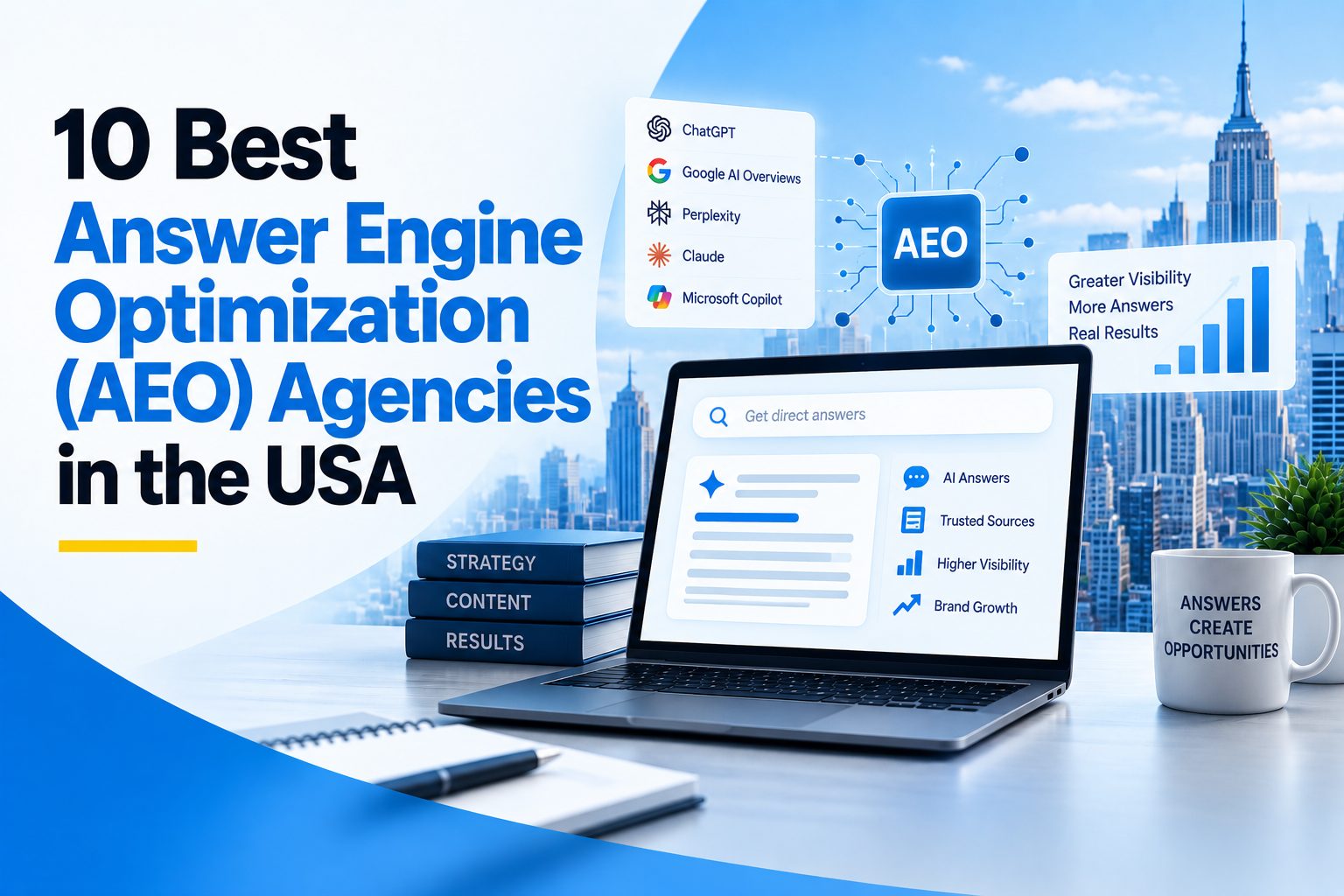
10 Best Answer Engine Optimization (AEO) Agencies in the USA
You weren’t ranked higher than your competitor; instead, it was quoted.
The difference is trivial in theory but massive in reality. While ranking is a position on a page someone still has to read, being quoted means an AI tool read the page, judged your competitor as the reliable source, and presented it as fact. The buyer never saw the comparison; they only saw the conclusion.
Marketing teams still measure the first, while buyers have moved to the second. Rankings hold steady, traffic softens, leads thin out, and nothing in the dashboard explains why.
Answer engine optimization fixes that gap. It goes by a few names, GEO and AI search among them, and the point of all is the same: be the source the answer is built from rather than a link below it.
Half the companies currently selling it offered a different product eighteen months ago. For this reason, we reduced the list to ten US firms that publish details of their methods and clearly state which customers they suit. There is no ranking or paid placement. Just a shortlist to start.
Why doesn’t my brand show up in AI answers?
Usually because the signals are thin: unclear entity data, content that is hard to lift, and few third-party mentions.
Which platforms count as answer engines?
ChatGPT, Perplexity, Gemini, Copilot, and Google AI Overviews are the ones most AEO programs track.
What does an AEO agency do?
Before the list, it helps to know what you are buying. AEO work usually covers several overlapping jobs:
- Entity building. Making sure AI systems understand what your company is, what it sells, and where it operates, consistently across the web.
- Content structure. Rewriting pages so answers sit near the top, headings are shaped like real questions, and comparisons are easy to lift.
- Schema and technical markup. FAQPage, Article, Organization, Product. The plumbing that makes content machine-readable.
- Third-party signals. Directory listings, rating platforms, industry publications. AI tools lean on sources they already trust.
- Citation tracking. Monitoring which prompts mention you, on which engine, and how that changes month to month.
Any agency worth talking to can walk you through all five. If the answer stops at “we add schema,” you are dealing with a partial program.
The 10 AEO Agencies in the USA at a glance
| MacRAE’S | Serves the US and Canada | AEO, GEO, LLM SEO, AI Visibility Engine | B2B, industrial, manufacturing |
| NoGood | New York, NY | Growth marketing with AI search as one channel | Venture-backed and consumer tech |
| iPullRank | New York, NY | Technical SEO and relevance engineering | Large, complex sites |
| First Page Sage | San Francisco, CA | Thought leadership content and entity authority | B2B, finance, legal, healthcare |
| Animalz | New York, NY | Editorial content built to be cited | SaaS and category leaders |
| Siege Media | San Diego, CA | Content plus earned links | Ecommerce and SaaS |
| Omniscient Digital | Austin, TX | Long-form content engineered for extraction | B2B SaaS |
| Avenue Z | New York and Boston | AI visibility tied to PR and reputation | Enterprise and consumer brands |
| Single Grain | Los Angeles, CA | Full-funnel digital with AI search layered in | Mid-market across sectors |
| Ignite Visibility | San Diego, CA | Broad digital marketing with AI search practice | Mid-market and enterprise |
- MacRAE’S
MacRAE’S works with B2B and industrial companies across the US and Canada. Its AEO work fits inside the SEO program a client already has rather than replacing it. That framing matters more than it sounds. Industrial buyers still search normally but also ask an assistant now, so both need coverage.
The agency runs a proprietary system called the AI Visibility Engine, which works across Google, ChatGPT, Bing, Perplexity, LinkedIn, industry directories, and voice assistants. The approach starts by identifying where a business loses visibility against competitors, then focuses fixes on pages and listings that generate conversions.
What it offers, in practice:
- AEO Services, GEO Services, and LLM SEO Services as separate programs
- Search Everywhere Optimization covering search, AI tools, directories, and voice.
- AI-powered content creation and technical content strategy
- Conversion-focused website design and development
- Industrial and B2B SEO across manufacturing, packaging, logistics, CNC, HVAC, data centers, and more
- Guidance pages on ranking inside Perplexity, ChatGPT, Gemini, and Claude
Suits: manufacturers, industrial suppliers, and B2B service companies selling into the US and Canada.
- NoGood
NoGood is a growth marketing team from New York that treats AI search as one channel within a wider program covering paid, content, lifecycle, and experimentation. They publish a fair amount about their testing process, including which prompts they track and which engines they monitor.
The value here is comparative. Running paid and organic side by side lets you see what each returns, which is harder to judge when AI search is your only channel.
Suits: funded companies with budget across several channels who want to test where AI search fits.
- iPullRank
Led by Mike King, iPullRank is known for technical depth. The agency extended its semantic SEO and knowledge graph work into relevance engineering, which optimizes how retrieval systems pick sources.
This option suits sites where the bottleneck is structural rather than editorial. Big taxonomies, international footprints, thousands of pages, that sort of thing.
Suits: enterprise and large-catalogue sites with real technical complexity.
- First Page Sage
First Page Sage built its reputation on thought leadership content and carried that model into AI search. The thesis is simple: AI tools tend to cite the source which defined a topic, so become that source.
Their work is organized around verticals including B2B tech, financial services, healthcare, and legal. It is a compounding approach that rewards patience more than urgency.
Suits: established B2B companies building long-term category authority.
- Animalz
Animalz has been a reference point for B2B SaaS content for years, and the editorial standard has not slipped with AI search. They write long, considered pieces that language models treat as canonical.
If you publish plenty but get cited by nobody, this is a useful direction. Know that the technical layer is not their core, and they will tell you so.
Suits: SaaS and B2B brands where content quality is the constraint.
- Siege Media
Siege Media pairs content production with link earning, a reasonable fit for AI search given how much weight these tools place on third-party validation. Comparison pages, bottom-of-funnel content, and data-led pieces are their usual output.
They maintain a high level of output without compromising on quality, a combination which is more difficult to achieve than it may seem.
Suits: ecommerce and SaaS brands that need both output and authority.
- Omniscient Digital
Omniscient Digital builds content engines for B2B software companies, with an increasing emphasis on structure that AI tools can pull from cleanly, question-shaped headings, direct answers near the top, and tables thThe content is usually quite long, a feature that is appropriate for categories in which customers take the time to research before contacting anyone.e talking to anyone.
Suits: B2B SaaS teams whose content is producing traffic but not citations.
- Avenue Z
Avenue Z comes at AI visibility from the PR side. The reasoning: AI tools cite sources they trust; trust is built through coverage and third-party validation, so earned media and AEO belong in the same program.
They keep an index that rates brand presence among the major AI engines, and the work involved is comparable to that of agencies that use the AEO label.
Suits: larger brands where reputation and press coverage are already part of the picture.
- Single Grain
Single Grain runs full-fledged digital marketing out of Los Angeles, with AI search folded into a more extensive mix that includes paid, SEO, and content. Founder Eric Siu is fairly visible on the topic through podcasts and newsletters, which makes their thinking easy to evaluate before you talk to anyone.
Suits: mid-market companies who want one partner across several channels rather than a specialist per lane.
- Ignite Visibility
Ignite Visibility is a big agency based in San Diego offering services in SEO, paid advertising, email, and social media, and it has a specific practice focusing on AI search; the training materials that it produces and the frameworks that it has published are rather detailed for an agency of its size.
The advantage in this situation is the wide range of services offered under a single umbrella, something that appeals to some teams but irritates others.
Suits: mid-market and enterprise teams consolidating vendors.
How to compare AEO Services in the USA?
The main differences between the various agencies are evident during the first discussion, provided that you ask the right questions.
| Which engines do you work across? | ChatGPT, Perplexity, Gemini, Copilot, and Google AI Overviews, with different approaches for each | One platform only, or AI search described as identical to Google SEO |
| How do you measure it? | A named tracking tool, a defined prompt set, monthly movement per engine | General talk about AI readiness with nothing measurable behind it |
| Can I see the work? | Case studies with prompts, engines, and before and after positions | Logo walls and testimonials with no detail attached |
| What ships each month? | An itemized list of content, schema, retrofits, and reporting | A retainer with flexible scope and no deliverables named |
| Who are you wrong for? | A clear, quick answer | A claim that they serve every industry and stage equally well |
The most informative of those remarks is the one which shows that an agency capable of identifying the client they are not a good fit for is concentrating on your outcome, whereas one that cannot do so is concentrating on the contract.
A realistic timeline
Nobody can promise a date, since every platform picks its own sources. But a rough shape does show up across most programs.
- In weeks 1 to 4, you will have an audit carried out, the entity will be cleaned up, the schema will be put in place and structural corrections will be made to your most heavily visited pages.
- Between the second and fourth months, mentions begin to appear on some engines for tracked prompts, typically starting with the ones that are less contested.
- Months 4 to 6: more regular presence, and focus turns toward converting the traffic AI tools send you.
The level of your domain authority, the technical state of your site, and the depth of content you already have will all have an effect on this.
Where to start
Pick two or three from this list that match your category and stage, then ask all of them the same five questions above. The gap between the answers will tell you more than any comparison table can. And before any of that, run a few prompts about your own category and see who comes up. If it is not you, at least now you know what the work is called.
Frequently Asked Questions
What is an AEO agency?
How is AEO different from SEO?
Can an agency guarantee I appear in ChatGPT?
Shall I need to rebuild my website first?
Author

Tanvir Singh Chawla is an accomplished sales and marketing leader with over eight years of experience across the automotive and digital marketing industries. Currently the Digital Strategy Lead at MacRAE’S Digital Marketing Agency, Tanvir specializes in developing and executing high-impact digital strategies, demand generation campaigns, and client success ... Read More
Contact us to explore how we can help your business grow.