
Contact US

Top AI Visibility Tools to Track Your Brand Performance in 2026

Have you noticed something strange happening with your website traffic? Your search rankings look solid, maybe even improving, but your organic traffic is mysteriously dropping. If this sounds familiar, you’re not experiencing a glitch in your analytics—you’re witnessing a fundamental shift in how people search for information.
AI-powered platforms like ChatGPT, Perplexity, and Google’s AI Overviews are changing the game. Instead of clicking through to websites, users are getting their answers delivered directly through AI-generated responses. If your brand isn’t appearing in those answers, you’re essentially invisible to a massive and growing portion of your potential audience.
Here’s what makes this situation particularly challenging: your traditional analytics tools won’t tell you about this lost visibility. Your Google Analytics dashboard might look perfectly normal, your Search Console data might show stable impressions, but underneath, you’re losing ground to competitors who are showing up in AI responses.
Understanding the AI Visibility Gap
Think about how dramatically search behavior has evolved. Just a couple of years ago, someone researching “best CRM software for small businesses” would open multiple browser tabs, compare features across different websites, and spend time reading reviews on various platforms.
Today? That same person might simply ask ChatGPT or Claude for a recommendation and get a curated answer with specific suggestions—complete with reasoning—without ever leaving the AI interface. Or they might use Google’s AI Overview and receive a synthesized answer right at the top of the search results page, often satisfying their query without clicking through.
This paradigm shift means that earning citations and mentions within AI-generated responses is becoming just as critical as ranking on page one of traditional search results. The fundamental challenge is that most businesses have no idea when, where, or how often they’re being mentioned by these AI systems.
What AI Visibility Tools Actually Track
AI visibility tools solve a measurement problem. They monitor which LLM platforms cite your content and track your brand mentions in AI Overviews. They measure changes over time so you can evaluate whether your LLM SEO efforts are actually working.
Think of these tools as Google Analytics for AI search. Without this data, you’re guessing about what resonates with AI platforms. With it, you see exactly what content drives citations and what gets ignored.
These specialized tools provide insights into:
- When and where your brand appears in AI-generated answers across multiple platforms
- Which AI systems are citing your content as authoritative sources
- How frequently your brand gets mentioned compared to competitors
- What context surrounds your mentions —are you being recommended, referenced, or just named?
- Which queries or topics trigger your brand to appear in AI responses
- The sentiment and positioning of your mentions within AI-generated content
Essential AI Visibility Tools for 2026
Scrunch AI
Scrunch goes beyond “are we visible?” into “how do we increase visibility?” Its monitoring is paired with an Agent Experience Platform (AXP) that creates AI-readable layers for your site, intended to influence how assistants assemble answers.
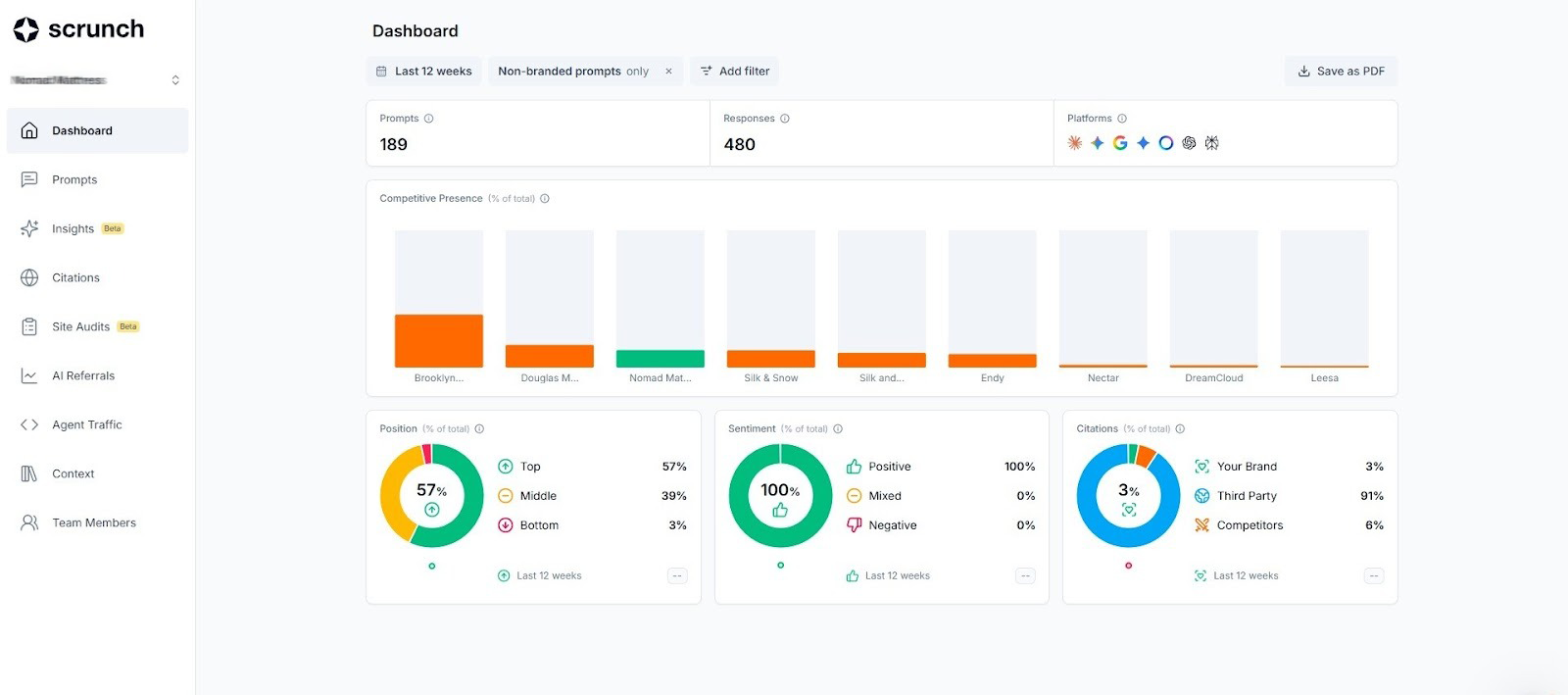
Key Features:
- Share of voice benchmarking across AI platforms
- Misinformation detection to identify when AI systems present incorrect information about your brand
- Customer journey mapping through AI touchpoints
- Infrastructure-level optimization recommendations
- Agent Experience Platform (AXP) for improving AI-readability
- Visibility lift measurement to prove ROI
Scrunch AI takes a more proactive approach than simple monitoring tools. Rather than just telling you where you appear, it helps you optimize your digital infrastructure to increase the likelihood that AI systems will cite you. This makes it particularly valuable for enterprise brands and agencies treating AI search as a primary acquisition channel.
The platform does require more implementation effort than simpler monitoring tools, but it offers deeper optimization capabilities in return—making it worth the investment for teams serious about dominating AI visibility in their category.
Profound
Profound is a platform specifically designed for enterprise brands that need detailed intelligence about how AI platforms discuss them. This goes beyond counting citations. The system analyzes the context around every brand mention, including sentiment (whether AI platforms position you positively or negatively), competitive mentions (which competitors get mentioned alongside your brand), and authority (topic clusters where you’re seen as an authority versus areas where others dominate).
Key Features:
- Comprehensive tracking across ChatGPT, Perplexity, Google AI Overviews, Microsoft Copilot, and more
- Deep sentiment analysis showing how you’re positioned
- Competitive intelligence reveals which rivals appear alongside you
- Authority mapping across different topic clusters
- Citation frequency and context analysis
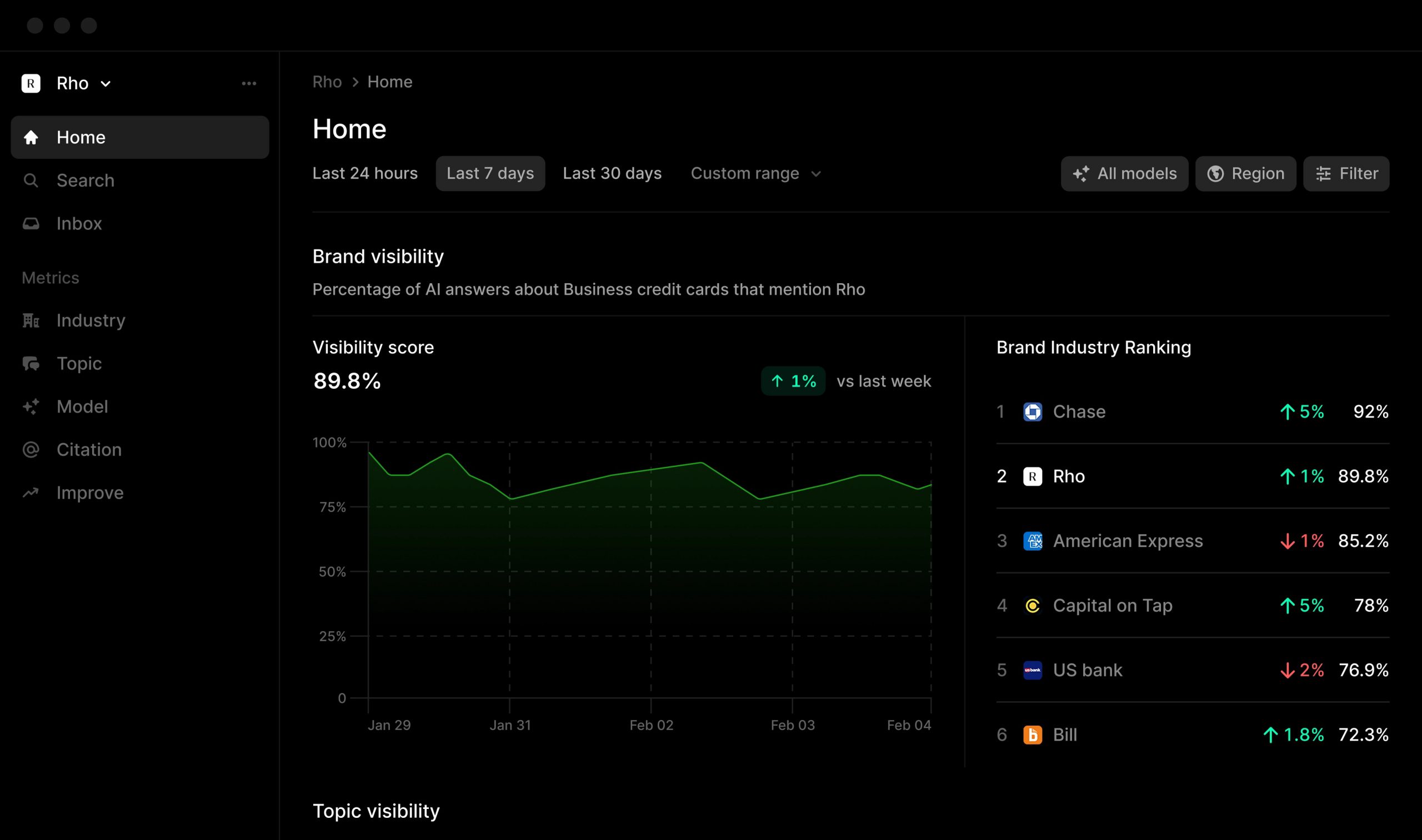
Profound is built for customization. Its team builds dashboards tailored to your industry, integrates with your existing systems, and creates reporting formats that match your organization’s workflow. Need specialized tracking for regulated industries? They configure it. Competitive intelligence can also be scaled across hundreds of queries, and alert systems can let you know if your brand suddenly drops from an AI response
The platform is ideal for enterprise teams where AI visibility directly impacts market position and revenue. While pricing is on the premium end (starting at $499/month for their Lite plan with enterprise plans requiring custom quotes), the depth and customization justify the investment for organizations treating AI search as a primary channel.
Semrush AI Visibility Tracking
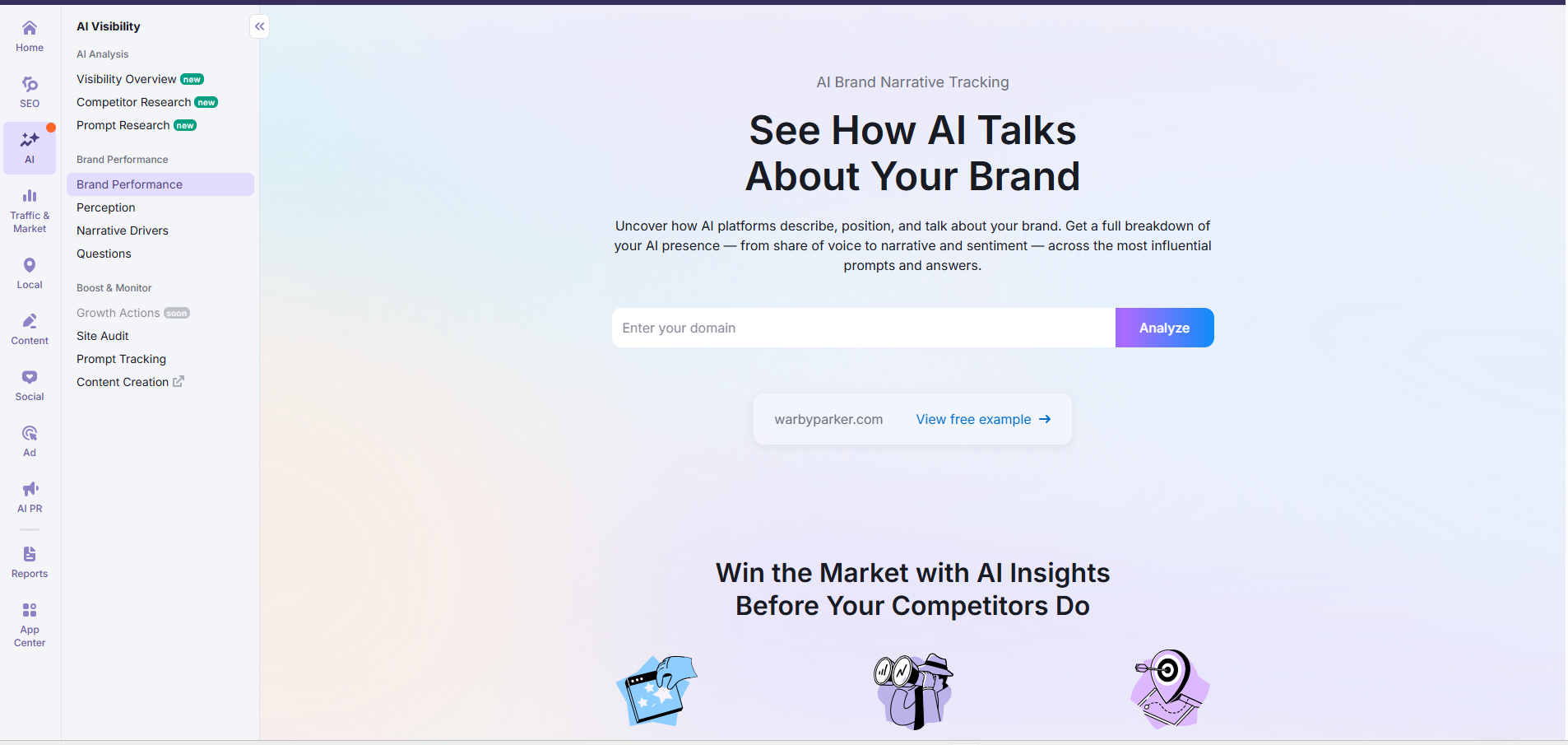
Semrush added AI visibility tracking to its existing SEO suite. Already using the platform? The new features integrate smoothly into your workflow. The tool monitors citations across major AI platforms and provides visibility scoring that works like domain authority, providing a single number showing how your AI presence compares to competitors over time.
Key Features:
- Seamless integration with existing Semrush SEO tools
- AI visibility scoring for easy benchmarking
- Multi-platform monitoring across major AI engines
- Correlation between traditional SEO performance and AI citations
- Unified dashboard combining all search visibility metrics
The real benefit of Semrush’s functionality is that it connects AI visibility data with everything else it already tracks. You can see which pages earn both backlinks and AI citations. You can see whether content that ranks in traditional search also appears in AI responses. That integrated view helps you understand what’s working across all your marketing channels.
Semrush is particularly valuable for teams already invested in the platform, as it eliminates the need to learn a new interface and keeps all visibility data centralized in one place.
Peec AI
Peec AI offers a streamlined approach to tracking brand presence across the evolving AI search landscape. The platform focuses on delivering actionable intelligence rather than overwhelming users with raw data, making it easier for marketing teams to move quickly from insight to action.
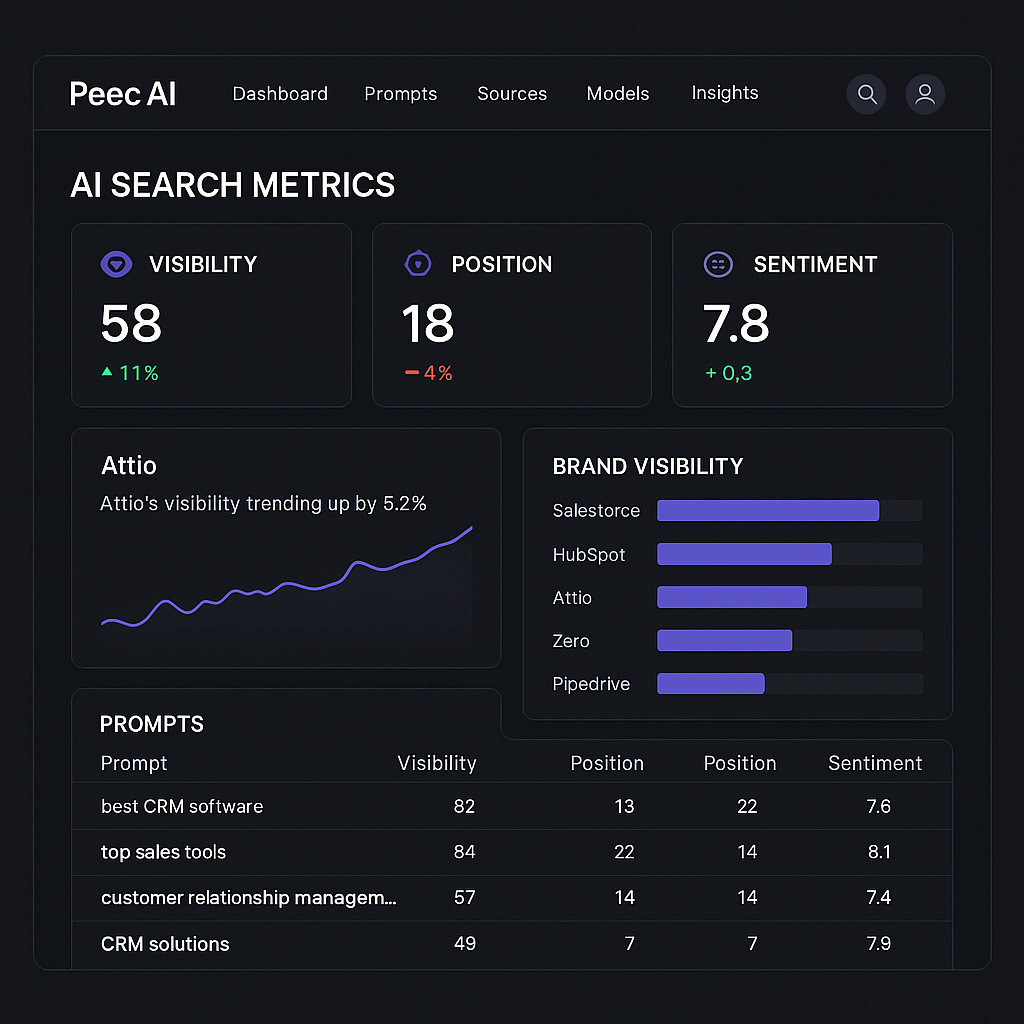
Key Features:
- Multi-platform monitoring across leading AI search engines including ChatGPT, Perplexity, and Google AI Overviews
- Share of voice analysis in AI-generated content to benchmark against competitors
- Topic and query mapping to identify high-value content opportunities
- Citation pattern analysis to understand what drives mentions
- Competitive positioning insights showing where rivals outperform you
- Real-time alerting for significant visibility changes
- Clean, intuitive interface designed for ease of use
- Efficient resource allocation for agencies managing multiple clients
Peec AI is designed for marketing teams that want to understand not just whether they’re being mentioned, but why certain content earns citations while other content gets ignored. The platform emphasizes identifying content gaps where improved visibility could drive meaningful business impact.
Brand Radar
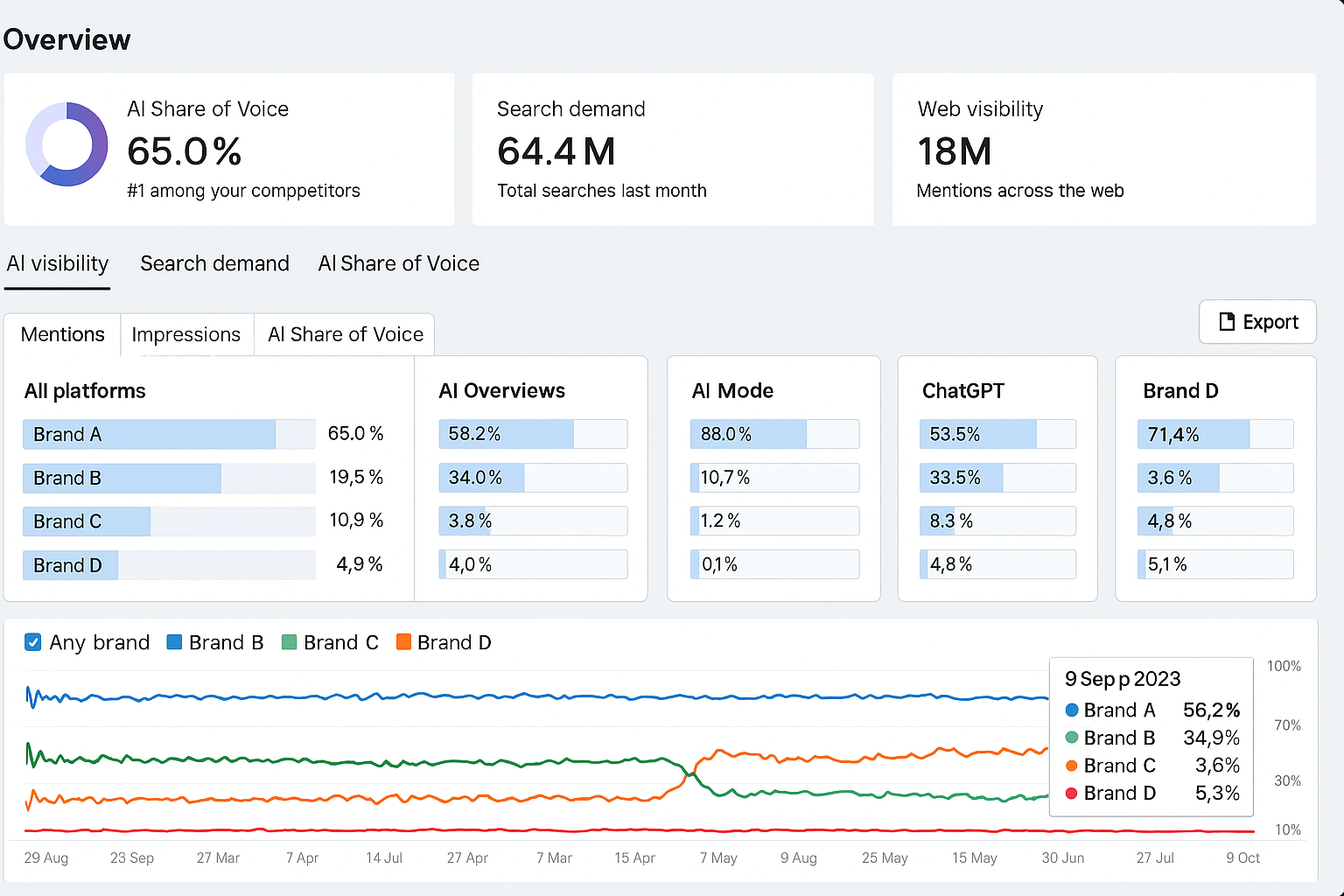
Brand Radar specializes in real-time monitoring of your brand’s presence across AI-powered search and conversation platforms. It’s built with a focus on competitive intelligence and market positioning, making it ideal for brands in crowded, competitive markets.
Key Features:
- Real-time alerts when your brand appears in AI responses
- Competitive comparison showing how your mentions stack up against rivals
- Multi-engine tracking across major AI platforms including ChatGPT, Perplexity, Claude, and Google AI
- Mention quality analysis distinguishing between primary citations and passing references
- Historical trend data to track visibility changes over time
- Regional and market-specific tracking capabilities
The platform excels at helping brands understand their competitive position in the AI visibility landscape. If you’re in a market where multiple competitors are vying for the same mindshare, Brand Radar’s comparative analytics become invaluable for identifying where you’re winning and where competitors have the edge.
Ahrefs AI Tracking
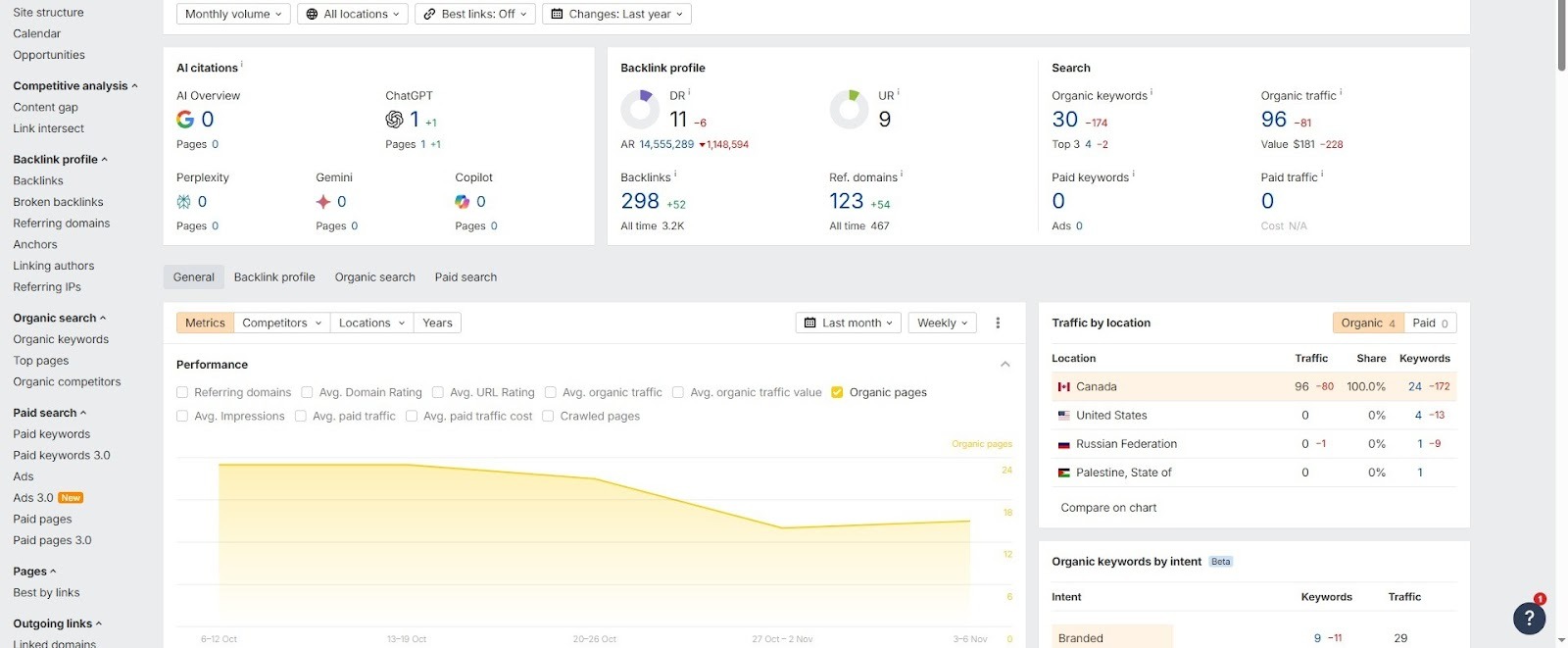
Platforms like Ahrefs combine both traditional SEO metrics and AI visibility tracking in unified dashboards. Ahrefs, long known as one of the most powerful SEO toolsets for backlink analysis and keyword research, has extended its capabilities to include AI visibility monitoring.
Key Features:
- Integration with Ahrefs’ comprehensive SEO data
- Tracking of brand mentions in AI-generated content
- Correlation between backlink profiles and AI citations
- Unified reporting combining traditional and AI visibility metrics
For teams already using Ahrefs for their SEO work, the AI visibility features provide a natural extension of their existing workflow without requiring a completely separate platform.
SE Ranking
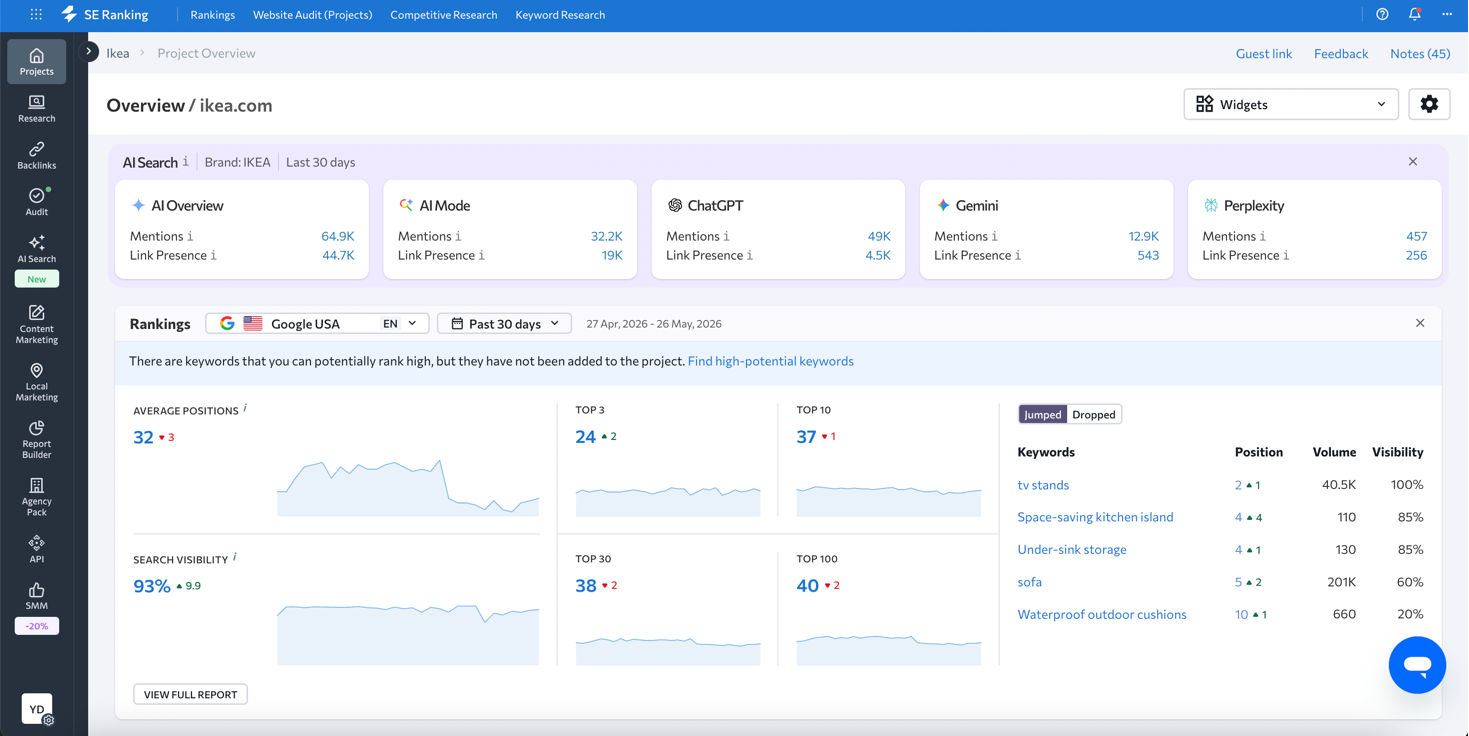
SE Ranking tracks AI search visibility within the same platform teams use for rank tracking, keyword research, competitive analysis, and site audits. Instead of adding AI performance metrics as a separate layer, SE Ranking connects visibility signals from AI Overviews, AI Mode, ChatGPT, Gemini, and Perplexity to existing organic and competitive data. This way, teams understand shifts in AI visibility alongside changes in traffic and rankings.
Key Features:
- Brand mention and citation tracking across Google AI Overviews, AI Mode, Gemini, ChatGPT, and Perplexity, with top-3 position data
- Most-cited source analysis to find key websites worth targeting for mentions
- Actionable AI visibility insights: untracked keywords, AI answers featuring competitors but not you, and more
- AI Competitor Research for analyzing any domain’s AI presence
- Daily updates with historical trend data to track visibility changes
- GA4 integration connecting AI visibility data to traffic performance
If AI mentions increase, drop, or shift toward competitors, users can compare those changes against keyword performance, traffic trends, and cited source patterns to understand what may be driving the movement. The Planable integration adds another layer by connecting social analytics to this picture and giving teams more context around brand presence across search, AI, and social channels.
For teams that need to pull AI search visibility data into their own systems, SE Ranking provides both an API and MCP integration. The API lets teams move AI visibility metrics into their own dashboards, reporting tools, and workflows. The MCP integration makes those insights accessible to AI assistants like Claude and Cursor, so teams can query and use the data more easily.
Choosing the Right AI Visibility Tool
Your Existing Stack: If you’re already using SE Ranking, Semrush, or Ahrefs for SEO, their AI visibility features extend current workflows. You avoid learning new interfaces and keep data centralized.
Why Traditional Analytics Miss the Mark
Your standard analytics stack—Google Analytics, Search Console, rank tracking tools—are exceptional at what they were designed to do: track clicks, impressions, rankings, and user behavior on your website. They’ve been refined over decades to provide detailed insights into the traditional search journey.
But here’s the problem: they become completely blind when someone asks ChatGPT for a recommendation, gets an answer from Perplexity, or finds what they need in Google’s AI Overview without clicking through to any website.
These “zero-click” interactions are invisible to traditional analytics. You won’t see:
- The query that triggered an AI response mentioning your brand
- Whether the AI positioned you favorably or just mentioned you in passing
- How many times AI systems recommended your product over a competitor’s
- Which of your content pieces AI platforms consider most authoritative
This creates a massive blind spot in your understanding of brand visibility and market position. You might be dominating AI recommendations in your category and have no idea. Or you might be completely absent from AI responses while your competitors rack up mentions—and your traditional tools wouldn’t show you either scenario.
The Strategic Importance of AI Visibility
The shift toward AI-mediated search isn’t a future concern—it’s happening right now. Research indicates that around 60 percent of searches now end without a click, with answer engines delivering results without sending users to websites.
ChatGPT alone processes over 2.5 billion prompts daily and serves more than 120 million users each day. That’s an enormous audience making decisions based on AI-generated recommendations, and traditional SEO can’t reach them.
Consider the implications for different business scenarios:
- For B2B SaaS companies: When a decision-maker asks an AI assistant for software recommendations, appearing in that response—and being positioned favorably—could mean the difference between making or missing a shortlist.
- For e-commerce brands: AI shopping assistants are becoming more sophisticated. If your products aren’t mentioned when someone asks for recommendations, you’ve lost the sale before they even knew you existed.
- For content publishers: When AI systems answer questions using your content but don’t cite you as the source, you’re providing value without getting credit—or traffic.
- For local businesses: Voice search through AI assistants is growing rapidly. When someone asks for “best Italian restaurant near me,” you need to be in that AI-generated answer.
Measuring What Matters in AI Visibility
Key metrics AI visibility tools track include: Brand Visibility (how often your brand gets mentioned across AI-generated answers in a given period), Industry Rank (your average position compared to other brands in your space), Top Prompts (the main questions people are asking in AI platforms relevant to your industry, and how your brand appears in those answers), and Competitor Visibility (how your brand’s presence in AI visibility trends compared to competitors over time).
Additional metrics to monitor:
- Citation Quality:Are you mentioned as a primary recommendation or just a passing reference? Quality matters more than quantity.
- Share of Voice: What percentage of AI mentions in your category belong to you versus competitors? This is your AI market position.
- Source Attribution: When AI systems cite your content, which specific pages or pieces get referenced? This tells you what’s working.
- Sentiment and Context: How are you being positioned? Are AI systems recommending you enthusiastically or mentioning you with caveats?
Choosing the Right AI Visibility Tool
The budget determines realistic options. Enterprise platforms like Profound deliver granular intelligence but require substantial financial commitment that only makes sense at scale. Technical capabilities matter—some platforms assume comfort with data analysis and provide extensive export, API, and customization options. Others prioritize simplicity with clear dashboards and straightforward recommendations.
Consider these factors:
- Your Existing Stack: If you’re already using Semrush or Ahrefs for SEO, their AI visibility features extend current workflows. You avoid learning new interfaces and keep data centralized.
- Team Size and Resources: Smaller teams might prefer simpler platforms with clear dashboards, while enterprise organizations may need the customization and depth of tools like Profound or Scrunch AI.
- Competitive Intensity: In highly competitive markets, tools like Brand Radar with strong competitive intelligence features become more valuable.
- Budget Reality: Monthly costs range from under $100 for basic tracking to several thousand dollars for enterprise-grade solutions with comprehensive features.
- Implementation Complexity: Some tools work out of the box, while others like Scrunch AI require more setup but offer deeper optimization capabilities.
Also Read:
Getting Started with AI Visibility Tracking
If you’re ready to start monitoring your AI visibility, here’s a practical approach:
- Start with One Tool: Don’t try to implement multiple platforms simultaneously. Choose one that fits your budget and needs—whether that’s Semrush for integrated SEO workflows, Brand Radar for competitive intelligence, or Profound for enterprise-grade analytics.
- Establish Your Baseline: Spend the first month simply understanding your current AI visibility. How often do you appear? In what contexts? Against which competitors?
- Identify Your Gaps: Look for high-value queries where competitors appear but you don’t. These represent your biggest opportunities.
- Connect to Business Outcomes: Track how changes in AI visibility correlate with other business metrics. Are periods of high AI citation associated with increased branded search, direct traffic, or conversions?
- Optimize Iteratively: Use insights from your visibility tool to improve content, add structured data, enhance expertise signals, and increase your chances of citation.
The Bottom Line
Traditional SEO metrics like page views, rankings, and backlinks still matter. But they tell only part of the story. Don’t ignore the growing segment of your audience interacting with your content through AI platforms. They might not visit your site, but their interactions still influence visibility and authority.
The search landscape has evolved, and traditional visibility metrics reveal only half the picture. As AI-powered search continues to expand, tracking your presence in AI-generated responses is becoming a crucial part of AI SEO strategies.
You can’t optimize what you can’t measure. AI visibility tools give you eyes into this new landscape, helping you understand where you stand, where you’re losing ground to competitors, and where opportunities exist to capture more of this growing search channel.
The brands paying attention today will outperform the ones waiting to catch up later. The tools exist. The data is available. Use it.
The question isn’t whether to track AI visibility—it’s how quickly you can start.
All interface images are created solely for representation purposes. They are intended for illustrative use only.